Heavy metal contamination, physicochemical properties, and environmental health risks of soils affected by rice mill effluents in Birnin Kebbi, Nigeria
DOI:
https://doi.org/10.63697/jeshs.2026.10075Keywords:
Hazard quotient (HQ), Iron (Fe), Public health, Rice mill effluent, Total Dissolved Solids (TDS).Abstract
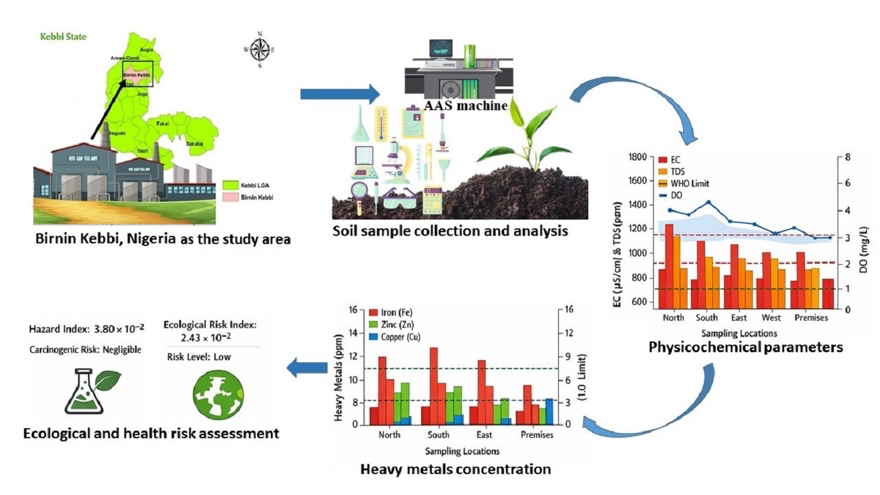
Rice mill effluents can degrade soil quality and introduce contaminants that pose ecological and public health risks, yet data from large-scale milling facilities in northern Nigeria remain limited. This study assessed the physicochemical characteristics, heavy metal concentrations, and associated health and ecological risks of soils surrounding Labana Rice Mill, Birnin Kebbi, Nigeria. Soil samples were collected from the mill premises and the cardinal directions (North, South, East, and West) and analyzed in the laboratory. The soils were slightly acidic, having pH values ranging between 6.20 and 6.62. Electrical conductivity (EC) exceeded the World Health Organization (WHO) guidelines (>1,500 µS/cm) in the North (1,510 µS/cm) and West (1,570 µS/cm) directions, while total dissolved solids (TDS) were also elevated in these locations (760–790 mg/L) compared to the WHO guidelines (<500 mg/L). Dissolved oxygen levels were low (2.3–2.9 mg/L) relative to WHO guidelines (6.5–8.0 mg/L), whereas temperature values (27.9–29.0°C) were within the normal ranges. Heavy metal analysis revealed elevated iron (Fe) concentrations above National Standards for Drinking Water Quality (NSDWQ) and WHO guidelines (1–3 mg/L) in the South (10.90 mg/L), North (12.60 mg/L), and West (13.60 mg/L) directions. Zinc (Zn) exceeded the WHO limit (3.0 mg/L) in the South (6.90 mg/L), and copper (Cu) exceeded the NSDWQ limit (1.0 mg/L) in the same location (2.00 mg/L). Lead (Pb) was below detection limits across all sites. Non-carcinogenic health risk assessment yielded a hazard index of 3.80 × 10⁻², while carcinogenic risk was negligible. Ecological risk was also low (2.43 × 10⁻²), with metal concentrations following the order: South > West > North > Premises > East. Positive correlations were observed between some physicochemical parameters and heavy metals, suggesting a common source. Although current exposure poses no immediate health risk, the detected contamination highlights the need for routine monitoring and improved pollution control measures.
Downloads
References
Adjovu, G. E., Stephen, H., & Ahmad, S. (2023). Spatiotemporal variability in total dissolved solids and total suspended solids along the Colorado River. Hydrology, 10(6), 125. DOI: https://doi.org/10.3390/hydrology10060125
Afrad, M. S. I., Monir, M. B., Haque, M. E., Barau, A. A., & Haque, M. M. (2020). Impact of industrial effluent on water, soil and rice production in Bangladesh: A case of Turag River Bank. Journal of Environmental Health Science and Engineering, 18(2), 825–834. DOI: https://doi.org/10.1007/s40201-020-00506-8
Ahmed, A. A., Kuranga, R. A., & Isola-Muyideen, O. L. (2025). Sustainability of peri-urban rice farming practices in Ilorin, Nigeria. International Journal of Research and Innovation in Social Science, 9(8), 2614–2628. DOI: https://doi.org/10.47772/IJRISS.2025.908000213
Ajah, D. N., Agboeze, E., Ihedioha, J. N., Chukwudi-Madu, E., & Chime, C. C. (2022). Levels of zinc (Zn), copper (Cu), iron (Fe), and cadmium (Cd) in soil, rice stalk, and Oryza Sativa grain in Ishiagu rice field, Ebonyi State, Nigeria; Human health risk. Journal of the Nigerian Society of Physical Sciences, 891. DOI: https://doi.org/10.46481/jnsps.2022.891
Akhtar, S., Luqman, M., Farooq Awan, M. U., Saba, I., Khan, Z. I., Ahmad, K., Muneeb, A., Nadeem, M., Batool, A. I., Shahzadi, M., Memona, H., Ahmad Shad, H., Mustafa, G., & Zubair, R. M. (2022). Health risk implications of iron in wastewater soil-food crops grown in the vicinity of peri urban areas of the District Sargodha. PLOS ONE, 17(11), e0275497. DOI: https://doi.org/10.1371/journal.pone.0275497
American Public Health Association (APHA) (2017). Standard methods for the examination of water and wastewater (23rd ed.). Washington, DC: American Public Health Association. Available at https://www.standardmethods.org/10.2105/SMWW.2882
Bai, J., Li, W., Zhang, Y., Xiao, L., Lu, W, & Li, Y. (2018). Distributions and risks of Cu, Cd, Pb and Zn in soils and rice in the North River Basin, South China. Earth and Environmental Science Transactions of the Royal Society of Edinburgh, 109(3–4), 483–493. DOI: https://doi.org/10.1017/S1755691018000646
Baptista, E., Liberal, Â., Cardoso, R. V. C., Fernandes, Â., Dias, M. I., Pires, T. C. S. P., Calhelha, R. C., García, P. A., Ferreira, I. C. F. R., & Barreira, J. C. M. (2024). Chemical and bioactive properties of red rice with potential pharmaceutical use. Molecules, 29(10), 2265. DOI: https://doi.org/10.3390/molecules29102265
Barroso, A., Valente, T., Marinho Reis, A. P., & Antunes, I. M. H. R. (2023). A new acidity-based approach for estimating total dissolved solids in acidic mining influenced water. Water, 15(16), 2995. DOI: https://doi.org/10.3390/w15162995
Belewu, K. F., Olanipekun, E., Adewale, E., & Ayinde, O. (2025). Analysis of rice prices and market integration: Case study of Nigeria (2016-2022). Agricultural and Biological Research, 41(4), 1-6.
Carvalho, A., Costa, R., Neves, S., Oliveira, C. M., & Bettencourt da Silva, R. J. N. (2021). Determination of dissolved oxygen in water by the Winkler method: Performance modelling and optimisation for environmental analysis. Microchemical Journal, 165, 106129. DOI: https://doi.org/10.1016/j.microc.2021.106129
Debassi, B., Allaoua, N., Ghanem, N., Hafid, H., Benacherine, M., & Chenchouni, H. (2025). Assessment of water quality of groundwater, surface water, and wastewater using physicochemical parameters and microbiological indicators. Science Progress, 108(2). DOI: https://doi.org/10.1177/00368504251348544
Dien, L. D., Hiep, L. H., Faggotter, S. J., Chen, C., Sammut, J., & Burford, M. A. (2019). Factors driving low oxygen conditions in integrated rice-shrimp ponds. Aquaculture, 512, 734315. DOI: https://doi.org/10.1016/j.aquaculture.2019.734315
Duan, S., Ai, H., Liu, S., Zhou, A., Cao, Y., & Huang, X. (2024). Functional nutritional rice: Current progresses and future prospects. Frontiers in Plant Science, 15, 1488210. DOI: https://doi.org/10.3389/fpls.2024.1488210
Erhuen, E., Okonkwo, H. N., Nwaezeapu, A. O., Wategire, O. P., & Akusu, P. O. (2024). The impact of rice milling activities on the quality of soil. International Journal of Innovative Science and Research Technology (IJISRT), 9, 2619–2626. DOI: https://doi.org/10.38124/ijisrt/IJISRT24JUN1730
Fazle Bari, A. S. M., Lamb, D., Choppala, G., Seshadri, B., Islam, Md. R., Sanderson, P., & Rahman, M. M. (2021). Arsenic bioaccessibility and fractionation in abandoned mine soils from selected sites in New South Wales, Australia and human health risk assessment. Ecotoxicology and Environmental Safety, 223, 112611. DOI: https://doi.org/10.1016/j.ecoenv.2021.112611
Fukagawa, N. K., & Ziska, L. H. (2019). Rice: Importance for global nutrition. Journal of Nutritional Science and Vitaminology, 65(Supplement), S2–S3. DOI: https://doi.org/10.3177/jnsv.65.S2
Hakanson, L. (1980). An ecological risk index for aquatic pollution control. A sedimentological approach. Water Research, 14 (8), 975-1001. DOI: https://doi.org/10.1016/0043-1354(80)90143-8
Hanjaniamin, A. E., Tabrizi, M. S., & Babazadeh, H. (2022). Dissolved oxygen concentration and eutrophication evaluation in Yamchi dam reservoir, Ardabil, Iran. Applied Water Science, 13(1), 9. DOI: https://doi.org/10.1007/s13201-022-01786-1
Hassan, P., Jusop, S., Ismail, R., Aris, A. Z., & Panhwar, Q. A. (2016). Soil and water quality of an acid sulfate soil area in Kelantan plains, Malaysia and its effect on the growth of rice. Asian Journal of Agriculture and Food Sciences, 4(3), 124–138.
Ibrahim, I., Suleiman, F., & Tijani, H. (2025). Costs and return analysis of irrigated rice production among small scale farmers in Birnin Kebbi local government area of Kebbi State. International Journal of Agricultural Economics, 10(2), 58–66. DOI: https://doi.org/10.11648/j.ijae.20251002.12
Islam, M., Nasrin, T., Rahman, M., Islam, M., & Ray, T. K. (2020). Quantitative constituents analysis of rice mill wastewater. Turkish Journal of Agriculture - Food Science and Technology, 8(10), 2034–2039. DOI: https://doi.org/10.24925/turjaf.v8i10.2034-2039.3042
Kandagatla, N., Kunnoth, B., Sridhar, P., Tyagi, V., Rao, P. V., & Tyagi, R. D. (2023). Rice mill wastewater management in the era of circular economy. Journal of Environmental Management, 348, 119248. DOI: https://doi.org/10.1016/j.jenvman.2023.119248
Kaur, K. (2019). Study of Ph and electrical conductivity in soil of Barnala District (Punjab, India): Deleterious effects on human lives. Transactions on Networks and Communications, 7(6), 17–26. DOI: https://doi.org/10.14738/tnc.76.7585
Kukwa, R. E., Ukpoko, U. W., & Leke, L. (2024). Assessment of physicochemical and minerals of wastewaters from food industries in Makurdi, for irrigation purposes. Water Science, 38(1), 475–484. DOI: https://doi.org/10.1080/23570008.2024.2392915
Kumar, S., & Deswal, S. (2021). A review on current techniques used in India for rice mill wastewater treatment and emerging techniques with valuable by-products. Environmental Science and Pollution Research, 28(7), 7652–7668. DOI: https://doi.org/10.1007/s11356-020-11898-3
Larance, S., Wang, J., Delavar, M. A., & Fahs, M. (2025). Assessing water temperature and dissolved oxygen and their potential effects on aquatic ecosystem using a SARIMA model. Environments, 12(1), 25. DOI: https://doi.org/10.3390/environments12010025
Lokman, N. A., Ithnin, A. M., Yahya, W. J., & Yuzir, M. A. (2021). A brief review on biochemical oxygen demand (BOD) treatment methods for palm oil mill effluents (POME). Environmental Technology & Innovation, 21, 101258. DOI: https://doi.org/10.1016/j.eti.2020.101258
Mishra, A. K., Pede, V. O., Arouna, A., Labarta, R., Andrade, R., Veettil, P. C., Bhandari, H., Laborte, A. G., Balie, J., & Bouman, B. (2022). Helping feed the world with rice innovations: CGIAR research adoption and socioeconomic impact on farmers. Global Food Security, 33, 100628. DOI: https://doi.org/10.1016/j.gfs.2022.100628
Mohidem, N. A., Hashim, N., Shamsudin, R., & Che Man, H. (2022). Rice for food security: Revisiting its production, diversity, rice milling process and nutrient content. Agriculture, 12(6), 741. DOI: https://doi.org/10.3390/agriculture12060741
Mohit, M., & Suprita, S. (2022). review on correlation between the total dissolved salts (TDS) and electrical conductivity (EC) of water samples collected from different area of Bhiwani city, Haryana, India. International Journal of Health Sciences, 5431–5438. DOI: https://doi.org/10.53730/ijhs.v6nS6.10821
Münzel, T., Hahad, O., Daiber, A., & Landrigan, P. J. (2023). Soil and water pollution and human health: What should cardiologists worry about? Cardiovascular Research, 119(2), 440–449. DOI: https://doi.org/10.1093/cvr/cvac082
Nabayi, A., Sung, C. T. B., Zuan, A. T. K., Paing, T. N., & Akhir, N. I. M. (2021). Chemical and microbial characterization of washed rice water waste to assess its potential as plant fertilizer and for increasing soil health. Agronomy, 11(12), 2391. DOI: https://doi.org/10.3390/agronomy11122391
NSDWQ (2007). Nigerian standard for drinking water. Nigerian Industrial Standard, NIS: 554, pp. 13–14. Available at: https://washnigeria.com/wp-content/uploads/2022/10/publications-Nigerian-Standard-for-Drinking-WaterQuality.pdf
Nwankwo, C. E. I., Okeke, E. S., Umeoguaju, F. U., Ejeromedoghene, O., Adedipe, D. T., & Ezeorba, T. P. C. (2025). Addressing emerging contaminants in agriculture affecting plant–soil interaction: A review on bio-based and nano-enhanced strategies for soil health and global food security (GFS). Discover Toxicology, 2(1). DOI: https://doi.org/10.1007/s44339-025-00018-w
Odewole, M. M, Sanusi, S. M., Sunmonu, O. M., Yerima, S., Mobolaji, D., & Olaoye, O. J. (2024). Digitalization of rice value chain in Nigeria with circular economy inclusion for improved productivity – A review. Heliyon, 10(11), e31611. DOI: https://doi.org/10.1016/j.heliyon.2024.e31611
Oniya, E. O., Olubi, O. E., Ibitoye, A., Agbi, J. I., Agbeni, S. K., & Faweya, E. B. (2018). Effect of milling equipment on the level of heavy metal content of foodstuff. Physical Science International Journal, 20(2), 1–8. DOI: https://doi.org/10.9734/PSIJ/2018/42572
Ramos Ramos, O. E., Chambi Tapia, M. I., Quino Lima, I., Rötting, T. S., Orsag, V., Chambi, L., Sracek, O., Quintanilla Aguirre, J., Maity, J. P., Ahmad, A., & Bundschuh, J. (2025). Trace elements in soils, their uptake by crops and potential health risks: Insights from a legacy mining area in Oruro, Bolivian Altiplano. Journal of Environmental Science and Health, Sustainable, 1(1), 8–26. DOI: https://doi.org/10.63697/jeshs.2025.029
Sen, D. J., Chaudhary, P. K., Chaudhari, S. V., Parmar, H. R., & Chaudhary, D. P. (2025). BOD Incubator Incubates by Biological Oxygen Demand to Reduce Pathogenic Load by Temperature Control. World Journal of Pharmaceutical and Medical Research, 11(11), 329–336.
Singh, R. K., & Bajpai, S. (2025). Study of biological treatment of rice mill wastewater using anaerobic semicontinuous reactors (ASCR). Nature Environment and Pollution Technology, 24(1), B4197. DOI: https://doi.org/10.46488/NEPT.2025.v24i01.B4197
Surma, S. K., Gesa, T. R. (2025). Influence of Rice Mill Solid Waste on Groundwater Chemical Composition in Tarka Local Government Area of Benue State. International Journal of Agriculture and Earth Science (IJAES), 11 (4), 42–51.
Tiwari, A. K., & Pal, D. B. (2022). Nutrients contamination and eutrophication in the river ecosystem. In Ecological Significance of River Ecosystems (pp. 203–216). Elsevier. DOI: https://doi.org/10.1016/B978-0-323-85045-2.00001-7
United States Environmental Protection Agency (USEPA) (2022). Framework for Metals Risk Assessment. Available at https://www.epa.gov/risk/framework-metals-risk-assessment (Accessed February 4, 2026).
von Mühlen, L., Prestes, O. D., Ferrão, M. F., & Sirtori, C. (2022). Miniaturized method for chemical oxygen demand determination using the PhotoMetrix PRO application. Molecules, 27(15), 4721. DOI: https://doi.org/10.3390/molecules27154721
World Health Organization (WHO) (2024). Guidelines for drinking-water quality: small water supplies. Available at https://www.who.int/publications/i/item/9789240088740 (Accessed December 7, 2025).
Xia, Y., Feng, J., Zhang, H., Xiong, D., Kong, L., Seviour, R., & Kong, Y. (2024). Effects of soil pH on the growth, soil nutrient composition, and rhizosphere microbiome of Ageratina adenophora. PeerJ, 12, e17231. DOI: https://doi.org/10.7717/peerj.17231
Yahaya, T. O. (2020). Level and health risk evaluation of heavy metals and microorganisms in urban soils of Lagos, Southwest Nigeria. Algerian Journal of Biosciences, 1(2). DOI: https://doi.org/10.57056/ajb.v1i2.27
Yahaya, T. O., Aliero, A. A., Oladele, E. O., Obadiah, C. D., Nathaniel, J., & Abdullahi, M. Z. (2021). Concentration and cytogenotoxicity of heavy metals and microorganisms in Labana Rice Mills wastewater Birnin Kebbi, Northwestern Nigeria. Nigerian Research Journal of Engineering and Environmental Sciences, 6(1), 216–225.
Yahaya, T. O., Anyebe, D. A., Adebayo, A. O., Adebisi, M. A., & Muhammad, S. S. (2019). Characterization and Toxicological Evaluation of Labana Rice Mill Wastewater in Kebbi State Nigeria. Uniport Journal of Engineering & Scientific Research, 4 (1), 34-42.
Yahaya, T. O., Bashar, D. M., Liman, U. U., Umar, J., Abdulrahim, A., & Gomo, C. B. (2023). Effects of pit latrines on borehole and well water in Maryland, Lagos, Nigeria. Journal of Advances in Environmental Health Research, 11(1), 20–27. DOI: https://doi.org/10.34172/jaehr.2023.03
Yahaya, T., Ologe, O., Yaro, C., Abdullahi, L., Abubakar, H., Gazal, A., & Abubakar, J. (2022). Quality and safety assessment of water samples collected from wells in four Emirate zones of Kebbi State, Nigeria. Iranian Journal of Energy and Environment, 13(1), 79–86. DOI: https://doi.org/10.5829/IJEE.2022.13.01.09
Zafar, S., & Jianlong, X. (2023). Recent advances to enhance nutritional quality of rice. Rice Science, 30(6), 523–536. DOI: https://doi.org/10.1016/j.rsci.2023.05.004
Zhang, Z., Chen, X., Pan, Z., Zhao, P., Zhang, J., Jiang, K., Wang, J., Han, G., Song, Y., Huang, N., Ma, S., Zhang, J., Yin, W., Zhang, Z., & Men, J. (2022). Quantitative estimation of the effects of soil moisture on temperature using a soil water and heat coupling model. Agriculture, 12(9), 1371. DOI: https://doi.org/10.3390/agriculture12091371
Downloads
Published
Data Availability Statement
The data can be made available upon request from the corresponding author.
Issue
Section
License
Copyright (c) 2026 Tajudeen Yahaya, Sha'awanatu Bello, Abdulrazaq Izuafa, Fauziya Inuwa, Umar Idris Boku, Josephine Nathaniel

This work is licensed under a Creative Commons Attribution-NonCommercial-NoDerivatives 4.0 International License.
Authors retain the copyright to their work and grant the journal and its publisher (Enviro Mind Solutions) a non-exclusive license to publish and distribute the work freely.
How to Cite