Marine pollution assessment and source mapping along the Visakhapatnam coast using remote sensing and GIS techniques
DOI:
https://doi.org/10.63697/jeshs.2026.10077Keywords:
Coastal pollution, Marine pollution index, Remote sensing, GISAbstract
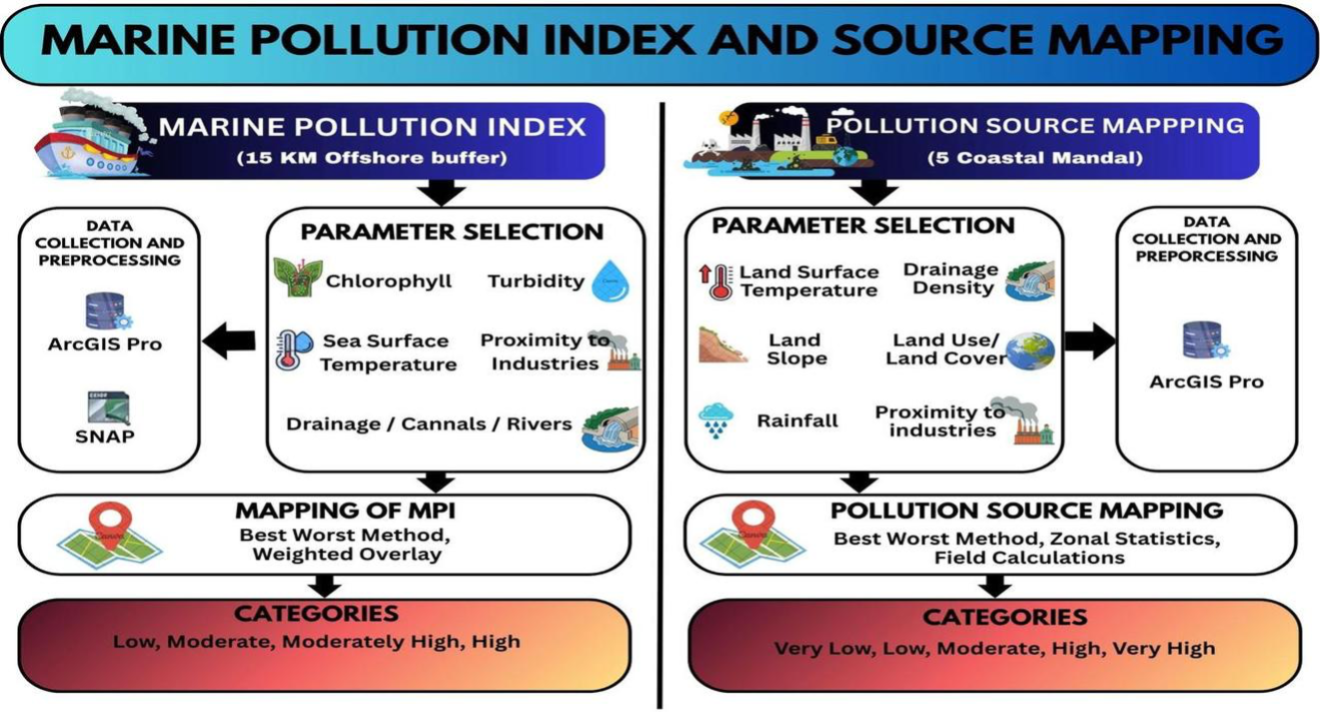
Marine pollution in coastal regions is a growing environmental concern, demanding integrated strategies for sustainable coastal management and spatial planning. This study assesses the spatial intensity and inland sources of marine pollution along the Visakhapatnam coast, extending from Bheemunipatnam in the north to Gangavaram in the south. A novel marine pollution index (MPI) was developed using a 15 km offshore buffer zone by integrating five marine parameters Chlorophyll-a, total suspended matter (TSM), sea surface temperature (SST), proximity to industrial and port areas, and proximity to drainage systems. All datasets were harmonized to a 1 km spatial resolution and objectively weighted using the Best Worst Method (BWM), a multi-criteria decision-making approach. Results identify proximity to drains/canals (0.4158) and industrial/port areas (0.2366) as the dominant contributors to marine pollution, followed by TSM (0.1577), Chlorophyll-a (0.1183), and SST (0.0717). To link marine impacts with inland drivers, a complementary geospatial analysis incorporating seven terrestrial parameters was conducted. The results reveal Visakhapatnam Urban as the primary source region, followed by Pedagantyada and Gajuwaka, while Bheemunipatnam shows minimal influence. This integrated marine-terrestrial framework offers a transferable decision support tool for identifying pollution hotspots and guiding targeted coastal management interventions.
Downloads
References
Andhra Pradesh Pollution Control Board (APPCB), (2022). Environmental Status Report: Visakhapatnam Industrial Region.
Behera, S., Tanuku, N. R. S., Moturi, S. R. K., Gudapati, G., Tadi, S. R., & Modali, S. (2023). Anthropogenic impact and antibiotic resistance among the indicator and pathogenic bacteria from several industrial and sewage discharge points along the coast from Pydibhimavaram to Tuni, East Coast of India. Environmental Monitoring and Assessment, 195(5). DOI: https://doi.org/10.1007/s10661-023-11083-2
Bhattacharya, R., Bhattacharya, R., Majeed, M., Bhandari, S., Aziz, R., Sinha, D., Mondal, A., & Niyogi, S. S. (2023). Environmental Rehabilitation of Industrial Waste Dumping Site. In Biohydrometallurgical Processes (pp. 44–89). CRC Press. DOI: https://doi.org/10.1201/9781003451457-4
Bhattacharya, S. N., Saha, B., Bhattacharya, M., & Basu, S. (2025). Will terrestrial biomes survive in the face of greenhouse gas emissions spillover: Insights from G20 countries. Journal of Environmental Management, 380, 125137. DOI: https://doi.org/10.1016/j.jenvman.2025.125137
Cheah, C. G., Chia, W. Y., Lai, S. F., Chew, K. W., Chia, S. R., & Show, P. L. (2022). Innovation designs of industry 4.0 based solid waste management: Machinery and digital circular economy. Environmental Research, 213, 113619. DOI: https://doi.org/10.1016/j.envres.2022.113619
Climate-Data.org. Visakhapatnam Climate (2025): https://en.climate-data.org/asia/india/andhra-pradesh/visakhapatnam-2804/
Das, G. K. (2022). Coastal environments of India. In Springer Water. Springer International Publishing. DOI: https://doi.org/10.1007/978-3-031-18846-6
Das, G. K. (2024). Analysing sea surface temperature and Chlorophyll-a distribution along Visakhapatnam coast using MODIS data. Knowledge-Based Engineering and Sciences, 5(2), 19–30. DOI: https://doi.org/10.51526/kbes.2024.5.2.19-30
Dey, S., & Majumdar, A. (2024). Current status of pollution in major rivers and tributaries of India and protection-restoration strategies. In Rivers of India (pp. 69–93). Springer International Publishing. DOI: https://doi.org/10.1007/978-3-031-49163-4_4
El-Alfy, M. A., El-Hamid, H. T. A., Keshta, A. E., Elnaggar, A. A., Darwish, D. H., Basiony, A. I., Alzeny, A. M., Abou-Hadied, M. M., Toubar, M. M., Shalby, A., & Shabaka, S. H. (2025). Assessing microplastic pollution vulnerability in a protected coastal lagoon in the Mediterranean Coast of Egypt using GIS modeling. Scientific Reports, 15(1), 11557. DOI: https://doi.org/10.1038/s41598-025-93329-2
Gunasekara, M. I., Mahawaththa, I., Madhubhashini, D., & Amarasena, K. (2025). Pollution from land‐based sources. In Coastal and Marine Pollution (pp. 27–44). Wiley. DOI: https://doi.org/10.1002/9781394237029.ch2
Halpern, B. S., Walbridge, S., Selkoe, K. A., Kappel, C. V., Micheli, F., D’Agrosa, C., Bruno, J. F., Casey, K. S., Ebert, C., Fox, H. E., Fujita, R., Heinemann, D., Lenihan, H. S., Madin, E. M. P., Perry, M. T., Selig, E. R., Spalding, M., Steneck, R., & Watson, R. (2008). A global map of human impact on marine ecosystems. Science, 319(5865), 948–952. DOI: https://doi.org/10.1126/science.1149345
Islam, M. S., & Tanaka, M. (2004). Impacts of pollution on coastal and marine ecosystems including coastal and marine fisheries and approach for management: a review and synthesis. Marine Pollution Bulletin, 48(7–8), 624–649. DOI: https://doi.org/10.1016/j.marpolbul.2003.12.004
Landrigan, P. J., Stegeman, J. J., Fleming, L. E., Allemand, D., Anderson, D. M., Backer, L. C., Brucker-Davis, F., Chevalier, N., Corra, L., Czerucka, D., Bottein, M.-Y. D., Demeneix, B., Depledge, M., Deheyn, D. D., Dorman, C. J., Fénichel, P., Fisher, S., Gaill, F., Galgani, F., … Rampal, P. (2020). Human health and ocean pollution. Annals of Global Health, 86(1), 151. DOI: https://doi.org/10.5334/aogh.2831
Indian Ports Association. (2023). Annual Port Performance Report 2022-2023: Visakhapatnam and Gangavaram Ports. https://www.shipmin.gov.in
Malone, T. C., & Newton, A. (2020). The globalization of cultural eutrophication in the coastal ocean: Causes and consequences. Frontiers in Marine Science, 7. DOI: https://doi.org/10.3389/fmars.2020.00670
Manini, E., Baldrighi, E., Ricci, F., Grilli, F., Giovannelli, D., Intoccia, M., Casabianca, S., Capellacci, S., Marinchel, N., Penna, P., Moro, F., Campanelli, A., Cordone, A., Correggia, M., Bastoni, D., Bolognini, L., Marini, M., & Penna, A. (2022). Assessment of spatio-temporal variability of faecal pollution along coastal waters during and after rainfall events. Water, 14(3), 502. DOI: https://doi.org/10.3390/w14030502
Mohammad, A. M., Bhaskara Rao, K., Dhanamjaya Rao, E. N., & Reddy, K. S. N. (2021). Major and trace elements’ concentration in recent clastic sediments from part of the eastern coast of India: an assessment of metal pollution. Environmental Earth Sciences, 80(9). DOI: https://doi.org/10.1007/s12665-021-09627-1
Mohan, N., Rao, N. S., Ghosh, S., & Meenakshi. (2025). Detection of marine plastics in the north Indian Ocean with optical and thermal information using google earth engine. Thalassas: An International Journal of Marine Sciences, 41(2). DOI: https://doi.org/10.1007/s41208-025-00835-1
Mukherjee, K. (2014). Analytic hierarchy process and technique for order preference by similarity to ideal solution: a bibliometric analysis “from” past, present and future of AHP and TOPSIS. International Journal of Intelligent Engineering Informatics, 2(2/3), 96-117. DOI: https://doi.org/10.1504/IJIEI.2014.066210
Nagamani, K., Devi, R. N. R. S., & Krishna, P. M. (2022). Study of Indian coastal geomorphology. Ecological Environment: A New Perspective (Edited Book), 45–60.
Nivedita, V., Begum, S. S., Aldehim, G., Alashjaee, A. M., Arasi, M. A., Sikkandar, M. Y., Jayasankar, T., & Vivek, S. (2024). Plastic debris detection along coastal waters using Sentinel-2 satellite data and machine learning techniques. Marine Pollution Bulletin, 209, 117106. DOI: https://doi.org/10.1016/j.marpolbul.2024.117106
Panigrahi, T., Periyasamy, M., Dutta, S., Chakraborty, A., & Dadhich, A. S. (2025). Geospatial assessment of inorganic heavy metal contamination and health risks in coastal and industrial areas of Visakhapatnam, India. International Journal of Environmental Analytical Chemistry, 105(19), 7987–8012. DOI: https://doi.org/10.1080/03067319.2025.2466620
Pati, S., Dash, M. K., Mukherjee, C. K., Dash, B., & Pokhrel, S. (2014). Assessment of water quality using multivariate statistical techniques in the coastal region of Visakhapatnam, India. Environmental Monitoring and Assessment, 186(10), 6385–6402. DOI: https://doi.org/10.1007/s10661-014-3862-y
Resmi, M. R., & Vaishnavi. (2025). Microplastic pollution in Indian aquatic ecosystems: Insights and implications. Water, Air, & Soil Pollution, 236(1), 62. DOI: https://doi.org/10.1007/s11270-024-07640-1
Rezaei, J. (2015). Best-worst multi-criteria decision-making method. Omega, 53, 49–57. DOI: https://doi.org/10.1016/j.omega.2014.11.009
Rezvani, S. M., Falcão, M. J., Komljenovic, D., & de Almeida, N. M. (2023). A systematic literature review on urban resilience enabled with asset and disaster risk management approaches and GIS-based decision support tools. Applied Sciences, 13(4), 2223. DOI: https://doi.org/10.3390/app13042223
Saaty, T. L. (2013). Analytic hierarchy process. In Encyclopedia of operations research and management science (pp. 52–64). Springer, Boston, MA. DOI: https://doi.org/10.1007/978-1-4419-1153-7_31
Saha, M., Naik, A., Desai, A., Nanajkar, M., Rathore, C., Kumar, M., & Gupta, P. (2021). Microplastics in seafood as an emerging threat to marine environment: A case study in Goa, west coast of India. Chemosphere, 270, 129359. DOI: https://doi.org/10.1016/j.chemosphere.2020.129359
Saha, S. (2016). Study of relation between environment and intensity of Tropical Cyclones formed in the Bay of Bengal during 2000-2011.
Satyanarayana, G. V., Byragi Reddy, T., Srikanth Vemuri, R. S. S., Suryanarayana Rao, K., & Karnena, M. K. (2021). A study on development of pollution index models and multivariate statistical analysis for heavy metals in the soils of APIIC, Visakhapatnam. Nature Environment and Pollution Technology, 20(1), 251–257. DOI: https://doi.org/10.46488/NEPT.2021.v20i01.027
Sood, A., Vignesh, K. S., & Prapanchan, V. N. (2025). Multi-hazard vulnerability zone identification using GIS-based fuzzy AHP and MCDM techniques. Natural Hazards, 121(7), 8501–8539. DOI: https://doi.org/10.1007/s11069-025-07125-2
Subbarayan, S., Thiyagarajan, S., Gangolu, S., Devanantham, A., & Nagireddy Masthan, R. (2024). Assessment of groundwater vulnerable zones using conventional and Fuzzy-AHP DRASTIC for Visakhapatnam district, India. Groundwater for Sustainable Development, 24, 101054. DOI: https://doi.org/10.1016/j.gsd.2023.101054
Subramanian, A., Nagarajan, A. M., Vinod, S., Chakraborty, S., Sivagami, K., Theodore, T., Sathyanarayanan, S. S., Tamizhdurai, P., & Mangesh, V. L. (2023). Long-term impacts of climate change on coastal and transitional eco-systems in India: an overview of its current status, future projections, solutions, and policies. RSC Advances, 13(18), 12204–12228. DOI: https://doi.org/10.1039/D2RA07448F
Swarna Latha, P., & Nageswara Rao, K. (2011). Use of geo-spatial information and technologies for analyzing morphological changes in the Greater Visakhapatnam coastal region, east coast of India. Geocarto International, 26(5), 391–411. DOI: https://doi.org/10.1080/10106049.2011.586733
Thiagarajan, C., & Devarajan, Y. (2025). The urgent challenge of ocean pollution: Impacts on marine biodiversity and human health. Regional Studies in Marine Science, 81, 103995. DOI: https://doi.org/10.1016/j.rsma.2024.103995
Vörösmarty, C. J., McIntyre, P. B., Gessner, M. O., Dudgeon, D., Prusevich, A., Green, P., Glidden, S., Bunn, S. E., Sullivan, C. A., Liermann, C. R., & Davies, P. M. (2010). Global threats to human water security and river biodiversity. Nature, 467(7315), 555–561. DOI: https://doi.org/10.1038/nature09440
Yucesan, M., & Gul, M. (2021). Failure prioritization and control using the neutrosophic best and worst method. Granular Computing, 6(2), 435–449. DOI: https://doi.org/10.1007/s41066-019-00206-1
Zhang, Y., Wang, J., Lu, J., & Wu, J. (2020). Antibiotic resistance genes might serve as new indicators for wastewater contamination of coastal waters: Spatial distribution and source apportionment of antibiotic resistance genes in a coastal bay. Ecological Indicators, 114, 106299. DOI: https://doi.org/10.1016/j.ecolind.2020.106299
Downloads
Published
Data Availability Statement
All datasets used in this study are publicly available from open-access repositories.
Issue
Section
License
Copyright (c) 2026 Nazeera Begum Pathan, Ibrahim Shaik, Pandu Brahmaji Rao

This work is licensed under a Creative Commons Attribution-NonCommercial-NoDerivatives 4.0 International License.
Authors retain the copyright to their work and grant the journal and its publisher (Enviro Mind Solutions) a non-exclusive license to publish and distribute the work freely.
How to Cite