Assessment of groundwater quality and trace elements toxicity in southern Brahmaputra floodplains: A health risk study
DOI:
https://doi.org/10.63697/jeshs.2026.10089Keywords:
Heavy metals, Groundwater chemistry, Health risk assessment, Principal component analysis, Brahmaputra floodplainAbstract
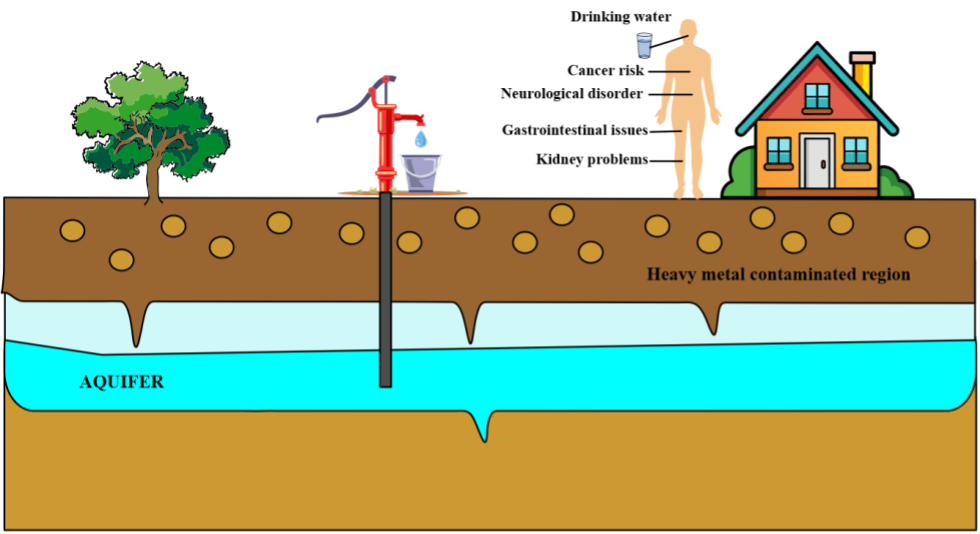
Groundwater, which is a freshwater reserve, is becoming a global concern due to its high extraction and contamination. This study investigated the contamination of heavy metals in groundwater, the potential health hazards it causes, and the essential role of monitoring and mitigating environmentally induced influences on water resources in southern Brahmaputra floodplains, India. The parameters: pH, TDS (total dissolved solids), EC (electrical conductivity), Hardness, HCO3–, SO42–, Na+, Ca2+, Cl–, Mg2+, F–, K+, NO3– including heavy metals such as As (arsenic), Cu (copper), Pb (lead), Mn (manganese), Fe (iron), Zn (zinc) and Cd (cadmium) were analyzed. In Sivasagar district, the groundwater and surface water are slightly alkaline, with hardness, EC and TDS all within permissible limits. Na⁺ followed by Ca²⁺ are the cations predominant in the region, with HCO3– being the dominant anion. A high level of NO3– in some samples indicates contamination from anthropogenic sources like agricultural runoff and domestic waste. Silicate weathering and rock-water interaction influence the groundwater quality. Groundwater composition changes through natural processes, as well as industrial and agricultural activities, are further highlighted by principal component analysis (PCA). Heavy metal analysis revealed that Fe (88%), Pb (92%), and As (14%) exceeded permissible limits, with notably high Fe and Pb concentrations due to both anthropogenic and natural processes. Concentrations of Mn (92%) and Cd (12%) were also found to exceed the permissible limits. Heavy metal contamination indices indicate a high level of pollution, particularly for Cd. Carcinogenic risk (CR) is shown for children, females, and males due to exposure to As, Cd, and Pb, despite the major ions being within the permissible limit.
Downloads
References
Alao, J. O., Bello, A., Lawal, H., & Abdullahi, D. (2024). Assessment of groundwater challenge and the sustainable management strategies. Results in Earth Sciences, 2, 100049. DOI: https://doi.org/10.1016/j.rines.2024.100049
Alsubih, M., El Morabet, R., Khan, R. A., Khan, N. A., ul Haq Khan, M., Ahmed, S., Qadir, A., & Changani, F. (2021). Occurrence and health risk assessment of arsenic and heavy metals in groundwater of three industrial areas in Delhi, India. Environmental Science and Pollution Research, 28(44), 63017–63031. DOI: https://doi.org/10.1007/s11356-021-15062-3
Asomaning, J., Antwi, E. O., Laar, C., & Saka, D. (2023). Statistical and isotopic analysis of sources and evolution of groundwater. Physics and Chemistry of the Earth, Parts A/B/C, 129, 103337. DOI: https://doi.org/10.1016/j.pce.2022.103337
Atafar, Z., Mesdaghinia, A., Nouri, J., Homaee, M., Yunesian, M., Ahmadimoghaddam, M., & Mahvi, A. H. (2008). Effect of fertilizer application on soil heavy metal concentration. Environmental Monitoring and Assessment, 160(1–4), 83–89. DOI: https://doi.org/10.1007/s10661-008-0659-x
Badeenezhad, A., Soleimani, H., Shahsavani, S., Parseh, I., Mohammadpour, A., Azadbakht, O., Javanmardi, P., Faraji, H., & Babakrpur Nalosi, K. (2023). Comprehensive health risk analysis of heavy metal pollution using water quality indices and Monte Carlo simulation in R software. Scientific Reports, 13(1). DOI: https://doi.org/10.1038/s41598-023-43161-3
Barman, R., Dutta, S., Radhapyari, K., Datta, S., Raj, R., Ray, B., & Srivastava, S. K. (2022). Human health risk assessment of harmful heavy metals and uranium exposure in shallow aquifer of Nagaon, the highest populated district of Assam, India. Journal of the Geological Society of India, 98(10), 1407–1416. DOI: https://doi.org/10.1007/s12594-022-2188-6
Bhowmick, S., Pramanik, S., Singh, P., Mondal, P., Chatterjee, D., & Nriagu, J. (2018). Arsenic in groundwater of West Bengal, India: A review of human health risks and assessment of possible intervention options. Science of The Total Environment, 612, 148–169. DOI: https://doi.org/10.1016/j.scitotenv.2017.08.216
Brown, M. J., & Margolis, S. (2012). Lead in drinking water and human blood lead levels in the United States. MMWR Suppl. 2012 Aug 10, 61(4), 1–9. PMID: 22874873.
Bureau of Indian Standards (2012). Indian standard drinking water — specification (second revision).
CGWB. (2013). Ground water information booklet Bhiwani district. September 1–17.
Chakraborti, D., Rahman, M. M., Paul, K., Chowdhury, U. K., Sengupta, M. K., Lodh, D., Chanda, C. R., Saha, K. C., & Mukherjee, S. C. (2002). Arsenic calamity in the Indian subcontinent: What lessons have been learned? Talanta, 58(1), 3–22. DOI: https://doi.org/10.1016/S0039-9140(02)00270-9
Chaturvedi, A., Bhattacharjee, S., Singh, A. K., & Kumar, V. (2018). A new approach for indexing groundwater heavy metal pollution. Ecological Indicators, 87, 323–331. DOI: https://doi.org/10.1016/j.ecolind.2017.12.052
Choudhury, R., Nath, B., Rahman, M. M., Medhi, S., & Dutta, J. (2024). Hydrogeochemical characteristics of groundwater contamination in Guwahati city, Assam, India: Tracing the elemental threads. Journal of Environmental Management, 359, 120933. DOI: https://doi.org/10.1016/j.jenvman.2024.120933
Collin, S., Baskar, A., Geevarghese, D. M., Ali, M. N. V. S., Bahubali, P., Choudhary, R., Lvov, V., Tovar, G. I., Senatov, F., Koppala, S., & Swamiappan, S. (2022). Bioaccumulation of lead (Pb) and its effects in plants: A review. Journal of Hazardous Materials Letters, 3, 100064. DOI: https://doi.org/10.1016/j.hazl.2022.100064
Dauphiné, D. C., Ferreccio, C., Guntur, S., Yuan, Y., Hammond, S. K., Balmes, J., Smith, A. H., & Steinmaus, C. (2011). Lung function in adults following in utero and childhood exposure to arsenic in drinking water: preliminary findings. International Archives of Occupational and Environmental Health, 84(6), 591–600. DOI: https://doi.org/10.1007/s00420-010-0591-6
Edet, A. E., & Offiong, O. E. (2002). Evaluation of water quality pollution indices for heavy metal contamination monitoring. A study case from Akpabuyo-Odukpani area, Lower Cross River Basin (southeastern Nigeria). GeoJournal, 57(4), 295–304. DOI: https://doi.org/10.1023/B:GEJO.0000007250.92458.de
Gad, M., Gaagai, A., Agrama, A. A., El-Fiqy, W. F. M., Eid, M. H., Szűcs, P., Elsayed, S., Elsherbiny, O., Khadr, M., Abukhadra, M. R., Alfassam, H. E., Bellucci, S., & Ibrahim, H. (2024). Comprehensive evaluation and prediction of groundwater quality and risk indices using quantitative approaches, multivariate analysis, and machine learning models: An exploratory study. Heliyon, 10(17), e36606. DOI: https://doi.org/10.1016/j.heliyon.2024.e36606
Gibbs, R. J. (1970). Mechanisms controlling world water chemistry. Science, 170(3962), 1088–1090. DOI: https://doi.org/10.1126/science.170.3962.1088
Goswami, R., Kumar, M., Biyani, N., & Shea, P. J. (2020). Arsenic exposure and perception of health risk due to groundwater contamination in Majuli (river island), Assam, India. Environmental Geochemistry and Health, 42(2), 443–460. DOI: https://doi.org/10.1007/s10653-019-00373-9
Goswami, R., Neog, N., & Thakur, R. (2022). Hydrogeochemical assessment of groundwater quality for drinking and irrigation in Biswanath and Sonitpur district of the Central Brahmaputra Plain, India. Frontiers in Water, 4. DOI: https://doi.org/10.3389/frwa.2022.889128
Järup, L. (2003). Hazards of heavy metal contamination. British Medical Bulletin, 68(1), 167–182. DOI: https://doi.org/10.1093/bmb/ldg032
Kapaj, S., Peterson, H., Liber, K., & Bhattacharya, P. (2006). Human health effects from chronic arsenic poisoning–A review. Journal of Environmental Science and Health, Part A, 41(10), 2399–2428. DOI: https://doi.org/10.1080/10934520600873571
Kshetriya, D., Warjri, C. D., Kumar Chakrabarty, T., & Ghosh, S. (2021). Assessment of heavy metals in some natural water bodies in Meghalaya, India. Environmental Nanotechnology, Monitoring & Management, 16, 100512. DOI: https://doi.org/10.1016/j.enmm.2021.100512
Kumar, A., Ali, M., Kumar, R., Kumar, M., Sagar, P., Pandey, R. K., Akhouri, V., Kumar, V., Anand, G., Niraj, P. K., Rani, R., Kumar, S., Kumar, D., Bishwapriya, A., & Ghosh, A. K. (2021). Arsenic exposure in Indo Gangetic plains of Bihar causing increased cancer risk. Scientific Reports, 11(1). DOI: https://doi.org/10.1038/s41598-021-81579-9
Lall, U., Josset, L., & Russo, T. (2020). A snapshot of the world’s groundwater challenges. Annual review of environment and resources, 45(1), 171–194. DOI: https://doi.org/10.1146/annurev-environ-102017-025800
Laonamsai, J., Pawana, V., Chipthamlong, P., Chomcheawchan, P., Kamdee, K., Kimmany, B., & Julphunthong, P. (2023). Groundwater quality variations in multiple aquifers: A comprehensive evaluation for public health and agricultural use. Geosciences, 13(7), 195. DOI: https://doi.org/10.3390/geosciences13070195
Latif, M., Nasim, I., Ahmad, M., Nawaz, R., Tahir, A., Irshad, M. A., Al-Mutairi, A. A., Irfan, A., Al-Hussain, S. A., & Zaki, M. E. A. (2024). Human health risk assessment of drinking water using heavy metal pollution index: a GIS-based investigation in mega city. Applied Water Science, 15(1). DOI: https://doi.org/10.1007/s13201-024-02341-w
Mahanta, C., Enmark, G., Nordborg, D., Sracek, O., Nath, B., Nickson, R. T., Herbert, R., Jacks, G., Mukherjee, A., Ramanathan, A. L., Choudhury, R., & Bhattacharya, P. (2015). Hydrogeochemical controls on mobilization of arsenic in groundwater of a part of Brahmaputra river floodplain, India. Journal of Hydrology: Regional Studies, 4, 154–171. DOI: https://doi.org/10.1016/j.ejrh.2015.03.002
Marandi, A., & Shand, P. (2018). Groundwater chemistry and the Gibbs diagram. Applied Geochemistry, 97, 209–212. DOI: https://doi.org/10.1016/j.apgeochem.2018.07.009
Mohan, S. V., Nithila, P., & Reddy, S. J. (1996). Estimation of heavy metals in drinking water and development of heavy metal pollution index. Journal of Environmental Science and Health. Part A: Environmental Science and Engineering and Toxicology, 31(2), 283–289. DOI: https://doi.org/10.1080/10934529609376357
Mukanyandwi, V., Kurban, A., Hakorimana, E., Nahayo, L., Habiyaremye, G., Gasirabo, A., & Sindikubwabo, T. (2019). Seasonal assessment of drinking water sources in Rwanda using GIS, contamination degree (Cd), and metal index (MI). Environmental Monitoring and Assessment, 191(12). DOI: https://doi.org/10.1007/s10661-019-7757-9
Nath, B., Sahu, S. J., Jana, J., Mukherjee-Goswami, A., Roy, S., Sarkar, M. J., & Chatterjee, D. (2007). Hydrochemistry of arsenic-enriched aquifer from rural West Bengal, India: A study of the arsenic exposure and mitigation option. Water, Air, and Soil Pollution, 190(1–4), 95–113. DOI: https://doi.org/10.1007/s11270-007-9583-x
Nath, B., Chowdhury, R., Ni‐Meister, W., & Mahanta, C. (2022). Predicting the distribution of arsenic in groundwater by a geospatial machine learning technique in the two most affected districts of Assam, India: The Public Health Implications. GeoHealth, 6(3). DOI: https://doi.org/10.1029/2021GH000585
Oni, A. A., Babalola, S. O., Adeleye, A. D., Olagunju, T. E., Amama, I. A., Omole, E. O., Adegboye, E. A., & Ohore, O. G. (2022). Non-carcinogenic and carcinogenic health risks associated with heavy metals and polycyclic aromatic hydrocarbons in well-water samples from an automobile junk market in Ibadan, SW-Nigeria. Heliyon, 8(9), e10688. DOI: https://doi.org/10.1016/j.heliyon.2022.e10688
Piper, A. M. (1994). A graphic procedure in the geochemical interpretation of water‐analyses. Eos, Transactions American Geophysical Union, 25(6), 914–928. DOI: https://doi.org/10.1029/TR025i006p00914
R. C. (1983). Basic Ground-Water Hydrology. U.S. Geological Survey Water-Supply Paper 2220. 2. Langmuir, D. (1997). Aqueous Environmental Geochemistry. Prentice Hall. 3. Alley, W. M. (2006). Ground Water. American Geophysical Union.
Rahman, M. M., Ng, J. C., & Naidu, R. (2009). Chronic exposure of arsenic via drinking water and its adverse health impacts on humans. Environmental Geochemistry and Health, 31(S1), 189–200. DOI: https://doi.org/10.1007/s10653-008-9235-0
Rapant, S., & Krčmová, K. (2007). Health risk assessment maps for arsenic groundwater content: application of national geochemical databases. Environmental Geochemistry and Health, 29(2), 131–141. DOI: https://doi.org/10.1007/s10653-006-9072-y
Rapant, S., Cvečková, V., Fajčíková, K., Sedláková, D., & Stehlíková, B. (2017). Impact of calcium and magnesium in groundwater and drinking water on the health of inhabitants of the Slovak Republic. International Journal of Environmental Research and Public Health, 14(3), 278. DOI: https://doi.org/10.3390/ijerph14030278
Rushdi, M. I., Basak, R., Das, P., Ahamed, T., & Bhattacharjee, S. (2023). Assessing the health risks associated with elevated manganese and iron in groundwater in Sreemangal and Moulvibazar Sadar, Bangladesh. Journal of Hazardous Materials Advances, 10, 100287. DOI: https://doi.org/10.1016/j.hazadv.2023.100287
Shalhevet, J. (1994). Using water of marginal quality for crop production: Major issues. Agricultural Water Management, 25(3), 233–269. DOI: https://doi.org/10.1016/0378-3774(94)90063-9
Stanton, R. J., Jeffery, D. L., & Ahr, W. M. (2002). Early Mississippian climate based on oxygen isotope compositions of brachiopods, Alamogordo Member of the Lake Valley Formation, south-central New Mexico. Geological Society of America Bulletin, 114(1), 4–11. DOI: https://doi.org/10.1130/0016-7606(2002)114<0004:EMCBOO>2.0.CO;2
Stumm, W. and Morgan, J. J. (1996) Aquatic chemistry, chemical equilibria and rates in natural waters. 3rd Edition, John Wiley & Sons, Inc., New York.
Tiwari, D., & Bajpai, R. (2012). Assessment of water quality in terms of total hardness and iron of some freshwater resources of Kanpur and its suburbs. Nature Environment and Pollution Technology, 11(2), 235–238.
USEPA, 1999, Risk assessment guidance for superfund (RAGS). Volume I. Human health evaluation manual (HHEM). Part E. Supplemental guidance for dermal risk assessment, Washington, DC, USA.
Vinnarasi, F., Srinivasamoorthy, K., Saravanan, K., Rajesh Kanna, A., Gopinath, S., Prakash, R., Ponnumani, G., & Babu, C. (2022). Hydrogeochemical characteristics and risk evaluation of potential toxic elements in groundwater from Shanmughanadhi, Tamilnadu, India. Environmental Research, 204, 112199. DOI: https://doi.org/10.1016/j.envres.2021.112199
Wasserman, G. A., Liu, X., LoIacono, N. J., Kline, J., Factor-Litvak, P., van Geen, A., Mey, J. L., Levy, D., Abramson, R., Schwartz, A., & Graziano, J. H. (2014). A cross-sectional study of well water arsenic and child IQ in Maine schoolchildren. Environmental Health, 13(1). DOI: https://doi.org/10.1186/1476-069X-13-23
World Health Organization (2020). Guidelines for Drinking-Water Quality.
Wu, F., Fu, Z., Liu, B., Mo, C., Chen, B., Corns, W., & Liao, H. (2011). Health risk associated with dietary co-exposure to high levels of antimony and arsenic in the world’s largest antimony mine area. Science of The Total Environment, 409(18), 3344–3351. DOI: https://doi.org/10.1016/j.scitotenv.2011.05.033
Wu, J., Zhou, H., He, S., & Zhang, Y. (2019). Comprehensive understanding of groundwater quality for domestic and agricultural purposes in terms of health risks in a coal mine area of the Ordos basin, north of the Chinese Loess Plateau. Environmental Earth Sciences, 78(15). DOI: https://doi.org/10.1007/s12665-019-8471-1
Downloads
Additional Files
Published
Data Availability Statement
The supplementary data is provided. Raw data used in the analysis can be accessed upon request from the corresponding author.
Issue
Section
License
Copyright (c) 2026 Lisha Borgohain, Runti Choudhury

This work is licensed under a Creative Commons Attribution-NonCommercial-NoDerivatives 4.0 International License.
Authors retain the copyright to their work and grant the journal and its publisher (Enviro Mind Solutions) a non-exclusive license to publish and distribute the work freely.
How to Cite