Evaluating flood, sprinkler and drip irrigation systems for dragon fruit production in Bangladesh
DOI:
https://doi.org/10.63697/jeshs.2025.10049Keywords:
Energy consumption for irrigation, Fruit production costs, Irrigation costs, Irrigation depth, Irrigation intervalAbstract
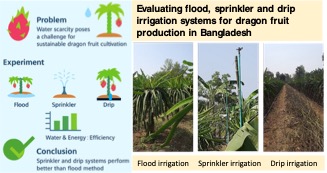
Water scarcity and inefficient irrigation practices are major challenges to sustainable fruit production in Bangladesh. Although dragon fruit (Hylocereus spp.) is relatively drought-tolerant, supplemental irrigation is crucial during flowering and fruiting to achieve high yield and fruit quality. In the Madhupur Tract, declining groundwater levels necessitate evaluating modern irrigation systems to promote efficient water use and ensure profitability. This study compared the performance of traditional flood, sprinkler, and drip irrigation systems for sustainable dragon fruit production. The focus was on water and energy use efficiency, productivity, farmer satisfaction, and economic viability (benefit–cost ratio, net present value, and payback period). Twelve dragon fruit farms were selected across the Madhupur Tract, representing each irrigation type. Data were collected on irrigated area, irrigation source, soil type, irrigation depth and interval, energy use, fruit yield and quality, user satisfaction (water distribution uniformity, runoff loss, waterlogging, soil erosion, water saving, and water quality), and installation and operation costs. Sprinkler and drip irrigation systems outperformed the traditional flood irrigation system in nearly all parameters. Drip irrigation delivered the highest irrigation water productivity (6.12 kg/m³) and the top benefit–cost ratio (2.08). It also provided water effectively (0.45 cm/event). Sprinkler systems achieved the highest land coverage (1.04 ha) and the best user satisfaction with the lowest energy demand (920 kWh/ha/year). Flood irrigation consumed the most water (2.1 cm/event), required the highest energy (2364 kWh/ha/year), and received the lowest satisfaction ratings. Sprinkler and drip systems delivered superior yields and fruit quality. Although their initial setup costs were higher, all systems achieved payback within a year, with drip and flood systems recovering costs the fastest (0.10 years). Overall, drip and sprinkler systems proved more efficient, profitable, and environmentally sustainable than conventional flood irrigation. The study recommends promoting precision irrigation technologies and providing targeted financial support for sustainable crop production in water-stressed regions.
Downloads
References
Alam, M.J., Hossain, M.A., Rahman, M.M., 2022. Comparative economic analysis of irrigation methods for vegetable cultivation in Bangladesh. Bangladesh Journal of Agricultural Economics, 45(2), 65–78.
Amin, M.G.M., Rahman, A., Akter, M.S., Rana, M.M., Shariot-Ullah, M., 2025. Hydrogeochemical response of aquifers to intensive groundwater pumping for rice-rice rotation. Groundwater for Sustainable Development, 30, 101485. DOI: https://doi.org/10.1016/j.gsd.2025.101485
Arivalagan, M., Karunakaran, G., Roy, T.K., Dinsha, M., Sindhu, B.C., Shilpashree, V.M., Satisha, G.C., Shivashankara, K.S., 2021. Biochemical and nutritional characterization of dragon fruit (Hylocereus species). Food Chemistry, 353, 129426. DOI: https://doi.org/10.1016/j.foodchem.2021.129426
BADC, 2024. Minor Irrigation Survey Report 2023-24. Digitalization of Survey and Monitoring for Development of Minor Irrigation Project, Sech Bhaban, Dhaka, June 2022. https://badc.portal.gov.bd/site/view/reports/
Bangladesh Bureau of Statistics (BBS), 2023. Yearbook of Agricultural Statistics 2023. Dhaka: Ministry of Planning, Government of Bangladesh.
Bian, C.Y., Ma, C. J., Liu, X.H., Gao, C., Liu, R., Yan, Z.X., Ren, Y.J., Li, Q.Q., 2016. Responses of winter wheat yield and water use efficiency to irrigation frequency and planting pattern. PLoS One, 11(5), e0154673. DOI: https://doi.org/10.1371/journal.pone.0154673
BMD, 2024. Bangladesh Meteorological Department, Dhaka, Bangladesh. https://live6.bmd.gov.bd
Bozhurin, K., 2024. Dragon fruit life cycle: Growing stages explained. https://growplant.org/blog/dragon-fruit-life-cycle/ (accessed in August 2025)
Chapai, A., Upadhayaya, K.P., Adhikari, S., Thapa, K., 2024. Dragon fruit farming in Nepal: a comprehensive review. International Journal of Horticulture, 14, 150–156. DOI: https://doi.org/10.5376/ijh.2024.14.0017
Chaudhary, J.N., Li, H., Jiang, Y., Pan, X., Hussain, Z., Javaid, M., Rizwan, M., 2024. Advances in sprinkler irrigation: A review in the context of precision irrigation for crop production. Agronomy, 14(1), 47. DOI: https://doi.org/10.3390/agronomy14010047
CIMMYT, 1988. From agronomic data to farmer recommendations: An economics training manual. CIMMYT, Mexico, D.F. http://hdl.handle.net/10883/3842
Cui, Z., Yan, B., Gao, Y., Wu, B., Wang, Y., Wang, H., Xu, P., Zhao, B., Cao, Z., Zhang, Y., Xie, Y., Hu, Y., Ma, X., Niu, J., 2022. Agronomic cultivation measures on productivity of oilseed flax: A review. Oil Crop Science, 7(1), 53–62. DOI: https://doi.org/10.1016/j.ocsci.2022.02.006
Du, T., Kang, S., Zhang, J., Davies, W.J., 2015. Deficit irrigation and sustainable water resource strategies in agriculture for China’s food security. Journal of Experimental Botany, 66, 2253–2269. DOI: https://doi.org/10.1093/jxb/erv034
Eco-Business, 2022. Water-stressed Bangladesh looks to recharge its fast-depleting aquifers. https://www.eco-business.com/news/fast-depleting-aquifers-signal-looming-water-crisis-in-bangladesh/
Egashira, K., Karim, A.J.M.S., 2001. Recent rainfall conditions in Madhupur Tract of Bangladesh. Journal of the Faculty of Agriculture, Kyushu University, 46. 69-74. DOI: https://doi.org/10.5109/24423
Fan, Y., Ding, R., Kang, S., Hao, X., Du, T., Tong, L., Li, S., 2017. Plastic mulch decreases available energy and evapotranspiration and improve yield and water use efficiency in an irrigated maize cropland. Agricultural Water Management, 179, 122–131. DOI: https://doi.org/10.1016/j.agwat.2016.08.019
Fang, Q., Zhang, X., Shao, L., Chen, S., Sun, H., 2018. Assessing the performance of different irrigation systems on winter wheat under limited water supply. Agricultural Water Management, 196, 133–143. DOI: https://doi.org/10.1016/j.agwat.2017.11.005
FAO, 2017. Guidelines for the Economic Analysis of Agricultural Projects. Food and Agriculture Organization of the United Nations, Rome.
FAO, 2020. Food and Agriculture Organization of the United Nations. The state of food and agriculture (2020): Overcoming water challenges in agriculture. FAO. https://www.fao.org/interactive/state-of-food-agriculture/2020/en/
Fernandez, J.E., Alcon, F., Diaz-Espejo, A., Hernandez-Santana, V., Cuevas, M.V., 2020. Water use indicators and economic analysis for on-farm irrigation decision: a case study of a super high density olive tree orchard. Agricultural Water Management, 233, 106074. DOI: https://doi.org/10.1016/j.agwat.2020.106074
Gittinger, J.P., 1982. Economic analysis of agricultural projects. Johns Hopkins University Press, Baltimore.
Harshitha, S., Nikhil, V., Tom, A., Likhith, P., Mohan, S., 2024. A comprehensive analysis of nutritional profile, cultivation techniques, and therapeutic potential of dragon fruit (Hylocereus spp.). Journal of Pharma Insights and Research, 2(5), 75–94. DOI: https://doi.org/10.69613/9c4q6n55
Hossain, M.M., Islam, M.R., 2022. Farmers’ participatory alternate wetting and drying irrigation method reduces greenhouse gas emission and improves water productivity and paddy yield in Bangladesh. Water, 14 (7), 1056. DOI: https://doi.org/10.3390/w14071056
Hossain, M., Numan, S., Akhtar, S., 2021. Cultivation, nutritional value, and health benefits of dragon fruit (Hylocereus spp.): A review. International Journal of Horticultural Science and Technology, 8(3), 259–269. https://ijhst.ut.ac.ir/article_80693_30cfe598b15e300767dcd5f8f646f175.pdf
Islam, M., Van Camp, M.F., Hossain, D., Walraevens, K., 2021. Impacts of large-scale groundwater exploitation based on long-term evolution of hydraulic heads in Dhaka City, Bangladesh. Water, 13(10), 1357. DOI: https://doi.org/10.3390/w13101357
Islam, M.T., Ullah, M.M., Amin, M.G.M., Hossain, S., 2017. Rainwater harvesting potential for farming system development in a hilly watershed of Bangladesh. Applied Water Science, 7, 2523–2532. DOI: https://doi.org/10.1007/s13201-016-0444-x
Jensen, C.R., Ørum, J.E., Pedersen, S.M., Andersen, M.N., Plauborg, F., Liu, F., Jacobsen, S.E., 2014. A short overview of measures for securing water resources for irrigated crop production. Journal of Agronomy and Crop Science, 200, 333–343. DOI: https://doi.org/10.1111/jac.12067
Jha, S.K., Ramatshaba, T.S., Wang, G., Liang, Y., Liu, H., Gao, Y., Duan, A., 2019. Response of growth, yield and water use efficiency of winter wheat to different irrigation methods and scheduling in North China Plain. Agricultural Water Management, 217, 292–302. DOI: https://doi.org/10.1016/j.agwat.2019.03.011
Kakade, V.D., Morade, A.S., Salunkhe, V.N., Boraiah, K.M., Jinger, D., Singh, G., Chavan, S.B., Kumar, R., Pradhan, A., Jadhav, S., Magar, S., Patil, A., Doke, A., Jadhav, P., Nangare, D.D., Reddy, K.S., 2025. Dragon fruit cultivation in new areas: Challenges, management strategies, and insights from India. Discover Agriculture, 3(1), 168. DOI: https://doi.org/10.1007/s44279-025-00243-2
Kakade, V.D., Boraiah, K.M., Salunkhe, V.S., Nangare, D.D., Chavan, S.B., Wakchaure, G.C., Jadhav, S.D., Rajkumar, Kumar, K. Ravi, Taware, P.B., Tayade, A.S., Sammi Reddy K., 2023. Emerging technologies for enhancing productivity and quality of dragon fruit in water scarce and degraded areas. ICAR-NIASM, Baramati. Technical Folder no. 2023/56.
Karandish, F., Liu, S., de Graaf, I., 2025. Global groundwater sustainability: A critical review of strategies and future pathways. Journal of Hydrology, 657, 133060. DOI: https://doi.org/10.1016/j.jhydrol.2025.133060
Karunakaran, G., Arivalagan, M., Sriram, S., 2019. Dragon fruit country report from India. https://ap.fftc.org.tw/article/1603
Liu, O., Zhao, Z., Zhou, D., Cao, J., Qin, J., Cao, Y., He, Y., 2024. Study on the relationship between groundwater and land subsidence in Bangladesh combining GRACE and InSAR. Remote Sensing, 16(19), 3715. DOI: https://doi.org/10.3390/rs16193715
Liu, H.J., Kang, Y., 2006. Effect of sprinkler irrigation on microclimate in the winter wheat field in the North China Plain. Agricultural Water Management, 84(1–2), 3–19. DOI: https://doi.org/10.1016/j.agwat.2006.01.015
Mahbub, S.M.M., Amin, M.G.M., Sarker, K.K., Maya, M., Haque, M.S., 2023. Closing the gap between theory and practice in tobacco irrigation in Bangladesh: Experiment and modeling. Water Conservation Science and Engineering, 8, 5. DOI: https://doi.org/10.1007/s41101-023-00183-2
Mahmud, K., Amin, M.G.M., Ahmed, U., Chowdhury, A.I., Hasan, M.M., Rahman, M.N., Khan, M.H., 2021. Status and sustainability challenges of agricultural water usage in Bangladesh. Agricultural Engineering International: CIGR Journal, 23(3), 84–100. https://cigrjournal.org/index.php/Ejounral/article/view/6973
Mitra, A., Alam, M.F., Yashodha., 2021. Solar irrigation in Bangladesh: A situation analysis report. International Water Management Institute (IWMI). https://solar.iwmi.org/wp-content/uploads/sites/43/2021/09/BANGLADESH-SITUATION-ANALYSIS-REPORT_final-version-2.pdf DOI: https://doi.org/10.5337/2021.216
Mondol, M.S.A., Akbar, U., Mandal, O., Rani, A., Dar, A.H., Chatterjee, A., Abdi, G., 2025. Advances in agronomic practices, postharvest technologies, and medicinal potential of dragon fruit (Hylocereus spp.): A comprehensive updated review. Journal of Agriculture and Food Research, 22, 102157. DOI: https://doi.org/10.1016/j.jafr.2025.102157
Monir, M.M., Sarker, S.C., Biswas, R.N., Islam, M.N., 2025. Assessment of the environmental impacts of regional groundwater flow path fluctuations in the water-stressed drought prone Northern Region of Bangladesh. Scientific Reports, 15, 4861. DOI: https://doi.org/10.1038/s41598-024-77617-x
Muslim, R., Widiastuti, I., Wijayanto, D.S., 2018. Development of an innovative irrigation system for dragon fruit farming. Journal of Mechanical Engineering and Vocational Education, 1(2), 65–69. DOI: https://doi.org/10.20961/jomeve.v1i2.26486
Narendra, V.N., Sahana, S., Chaithrashree, J., 2021. Economics of water used in arecanut under drip, sprinkler and flood irrigation method in arecanut growing areas of Chitradurga District of Karnataka, India. Biological Forum – An International Journal, 13(1), 511–516. https://www.researchtrend.net/bfij/bfij.php
Nurul, H., Asmah, R., 2014. Nutritional composition of dragon fruit varieties. Malaysian Journal of Nutrition, 20(1), 15–24.
Pandey, P., Kumar, P., 2024. Importance and advanced production practices for high-value dragon fruit (Hylocereus spp.) crop: A review. International Journal of Agricultural Sciences, 7(12A), 2090. DOI: https://doi.org/10.33545/2618060X.2024.v7.i12a.2090
Paredes, P., Rodrigues, G.C., Alves, I., Pereira, L.S., 2014. Partitioning evapotranspiration, yield prediction and economic returns of maize under various irrigation management strategies. Agricultural Water Management, 135, 27–39. DOI: https://doi.org/10.1016/j.agwat.2013.12.010
Parvin, M., Hossain, S., Rahman, A., 2019. Unsustainable groundwater depletion of Madhupur tract aquifer underneath Dhaka city and its relation to climate change. Conference: ICSNBE -2019, At: Dhaka, North South University.
Rahman, A., Amin, M.G.M., 2023. Soil hydraulic properties and field-scale hydrology as affected by land management options. Sains Tanah - Journal of Soil Science and Climatology, 20(1), 124–139. DOI: https://doi.org/10.20961/stjssa.v20i1.70504
Rahman, M.M., Haque, M.E., Islam, M.S., 2020. Profitability and resource use efficiency of maize production in different agro-ecological zones of Bangladesh. Journal of Bangladesh Agricultural University, 18(2), 353–360.
Ratul, A.A., Hoque, T.S., Islam, M.R., Hoque, M.A., 2021. Physico-chemical properties of acid soils from Madhupur Tract and Northern and Eastern Piedmont Plains of Bangladesh. Asian Journal of Medical and Biological Research, 7 (1), 12–20. DOI: https://doi.org/10.3329/ajmbr.v7i1.53304
Sarker, K.K., Hossain, A., Murad, K.F.I., Biswas, S.K., Akter, F., Rannu, R.P., Moniruzzaman, M., Karim, N.N., Timsina, J., 2019. Development and evaluation of an emitter with a low-pressure drip-irrigation system for sustainable eggplant production. AgriEngineering, 1(3), 376–390. DOI: https://doi.org/10.3390/agriengineering1030028
Seijger, C., Urfels, A., Christoforidou, M., Hellegers, P., Borghuis, G., Langan, S., van Halsema, G., 2025. More food, but less land and water for nature: Why agricultural productivity gains did not materialize. Agricultural Water Management, 307, 109229. DOI: https://doi.org/10.1016/j.agwat.2024.109229
Shankar, M.S., Ramanjaneyulu, A.V., Neelima, T.L., Das, A., 2015. Sprinkler irrigation – An asset in water scarce and undulating areas. Integrated Soil and Water Resource Management for Livelihood and Environmental Security. 259–283. ICAR Research Complex for NEH Region, Umiam – 793 103, Meghalaya, India.
SRDI (Soil Resource Development Institute), 2024. Annual report 2023–24. Ministry of Agriculture, Government of the People’s Republic of Bangladesh, Dhaka, Bangladesh.
The Business Standard. (2024, August 18). Sprinkler irrigation revolutionises fruit farming in Tangail. https://www.tbsnews.net/bangladesh/sprinkler-irrigation-revolutionises-fruit-farming-tangail-919121
Trivellini, A., Lucchesini, M., Ferrante, A., Massa, D., Orlando, M., Incrocci, L., Mensuali-Sodi, A., 2020. Pitaya, an Attractive Alternative Crop for Mediterranean Region. Agronomy, 10(8), 1065. DOI: https://doi.org/10.3390/agronomy10081065
Wang, X., Huo, Z., Guan, H., Guo, P., Qu, Z., 2018. Drip irrigation enhances shallow groundwater contribution to crop water consumption in an arid area. Hydrological Processes, 32, 747–758. DOI: https://doi.org/10.1002/hyp.11451
WARPO, 2025. Acts and rules. Water Resources Planning Organization. Water Acts 2013. https://warpo.gov.bd/site/page/d8a117d5-526a-4a14-9d77-4f5fa35a4f10/-
Wei, D., Wang, X., Luo, N., Zhu, Y., Wang, P., Meng, Q., 2023. Alleviating groundwater depletion while realizing food security for sustainable development. Journal of Cleaner Production, 393, 36351. DOI: https://doi.org/10.1016/j.jclepro.2023.136351
World Bank, 2020. Water in Agriculture. https://www.worldbank.org/en/topic/water-in-agriculture
Zazueta, F., 2018. Evaporation loss during sprinkler irrigation: BUL290/AE048, 11/2011. EDIS. DOI: https://doi.org/10.32473/edis-ae048-1994
Zhang, T., Zou, Y., Kisekka, I., Biswas, A., Cai, H., 2021. Comparison of different irrigation methods to synergistically improve maize’s yield, water productivity and economic benefits in an arid irrigation area. Agricultural Water Management, 243, 106497. DOI: https://doi.org/10.1016/j.agwat.2020.106497
Downloads
Published
Data Availability Statement
The supplementary data, including raw data files and code used for analysis, are available upon request from the corresponding author.
Issue
Section
License
Copyright (c) 2025 M. G. Mostofa Amin, Ummoy Sumaia Shammy, Md. Abdur Rouf, SSRM Mahe Alam Sorwar, Md. Rafizul Islam Mondal, Prodeep Kumar Sarker, Md. Habibur Rahman

This work is licensed under a Creative Commons Attribution-NonCommercial-NoDerivatives 4.0 International License.
Authors retain the copyright to their work and grant the journal and its publisher (Enviro Mind Solutions) a non-exclusive license to publish and distribute the work freely.
How to Cite