Groundwater salinization in inland basins of arid and semiarid climates: An overview
DOI:
https://doi.org/10.63697/jeshs.2025.10039Keywords:
Electrical conductivity, Nitrate-nitrogen, Total dissolved solids, Over-exploitation, Irrigation, Groundwater salinization, Arid and semiarid climatesAbstract
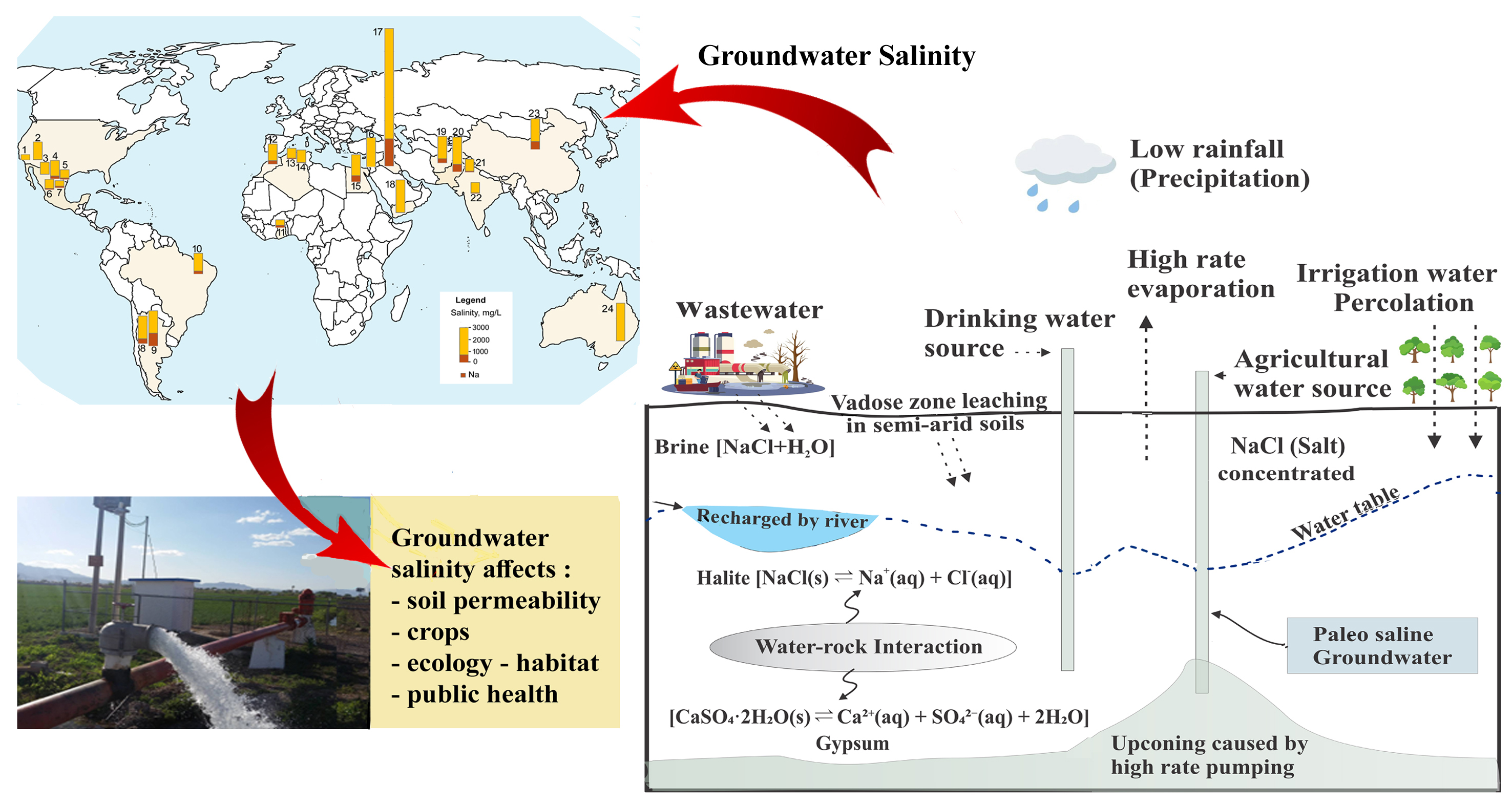
Salinization of aquifers is a growing global challenge in the aquifers ability to supply drinking and irrigation water, especially in regions with arid or semiarid climates. An analysis of key recent studies was conducted to identify the factors that lead to the severity of the salinity problem in vulnerable areas. The highest salinity values (averaging 2,000 mg/L to 12,000 mg/L) are reported for the Middle East and North Africa (MENA), resulting from the dissolution of carbonates, gypsum and halite. Intensive agriculture artificially raises the water table, favoring evaporation, which together with the infiltration of irrigation returns, significantly increases salinity. Latin American regions report unsustainable groundwater withdrawals and poor management as their main challenge. Overall, groundwater salinity evolves from Na-HCO3 and Ca-HCO3 types to Na-Cl type. Strategies aimed at reducing salinization consistently emphasize increased monitoring and effective water management practices, which vary according to each region. Two regions, northern Mexico and the food basket of Ghana, illustrate the differences and similarities of groundwater salinization in irrigated semiarid areas.
Downloads
References
Adhikary, P.P., Chandrasekharan, H., Dubey, S.K., Tridevi, S.M., Dash, C.J., 2015. Electrical resistivity tomography for assessment of groundwater salinity in west Delhi, India. Arabian Journal Geoscience, 8, 2687–2698. DOI: https://doi.org/10.1007/s12517-014-1406-y
Adimalla, N., Wu, J., 2019. Groundwater quality and associated health risks in a semi-arid region of south India: Implication to sustainable groundwater management. Human and Ecological Risk Assessment: An International Journal, 25(1–2), 191–216. DOI: https://doi.org/10.1080/10807039.2018.1546550
Ait Lemkademe, A., ElGhorfi, M., Zouhri, L., Heddoun, O., Khalil, A., Maacha, L., 2023. Origin and salinization processes of groundwater in the semi-arid area of Zagora graben, southeast Morocco. Water, 15, 2172. DOI: https://doi.org/10.3390/w15122172
Al Maliki, A., Kumar, S.U., Hasan Falih, A., Sultan, M.A., Al-Naemi, A., Alshamsi, D., Arman, H., Ahmed, A., Sabarathinam, C., 2024. Geochemical processes, salinity sources and utility characterization of groundwater in a semi-arid region of Iraq through geostatistical and isotopic techniques. Environmental Monitoring Assessment, 196, 365. DOI: https://doi.org/10.1007/s10661-024-12533-1
Anning, D., 2011. Modeled sources, transport, and accumulation of dissolved solids in water resources of the southwestern United States. Journal of American Water Resources Association, 47(5),1087–1109. DOI: https://doi.org/10.1111/j.1752-1688.2011.00579.x
Aouati, H., Demdoum, A., Kada, K., Kouadra, R., 2023. The impact of climate change on groundwater quantity and quality in a semi-arid environment: a case study of Ain Azel plain (Northeast Algeria). Acta Geochimica, 42, 1065–1078. DOI: https://doi.org/10.1007/s11631-023-00633-7
Asfahani, J., 2011. Electrical resistivity investigations for guiding and controlling fresh water well drilling in semi-arid region in Khanasser Valley, northern Syria. Acta Geophysica, 59, 139–154. DOI: https://doi.org/10.2478/s11600-010-0031-8
Asmoay, H., 2023. Evaluating groundwater quality and salinity dynamics in the Western‑west area of El Minya Governorate, Egypt, based on geochemical modelling and multivariate analysis. Journal of Umm Al-Qura University for Applied Science, 10, 91–101. DOI: https://doi.org/10.1007/s43994-023-00081-2
Batista Cruz, R.Y.; Liotta, M.; Batista Rodriguez, J.A.; Montecelos Zamora, Y., Kretzschmar, T.G., de la Garza Rodríguez, I.M., Canales Gutiérrez, L.E., Díaz Martínez, R., Blanco Moreno, J.A., Almaguer Carmenates, Y., Rodríguez Vega, A., de Jesús López Saucedo, F., 2022. Hydrochemical and isotopical characterization of the Region Carbonifera aquifer: An example of hydrogeological systems in the semi-arid climates of northeastern Mexico. Applied Geochemistry, 141, 105307. DOI: https://doi.org/10.1016/j.apgeochem.2022.105307
Becher-Quinodóz, F, Maldonado, L., Blarasin, M., Lutri, V., Cabrera, M.J., Albo G., Matteoda, E., 2019. Hydrogeological and hydrogeochemical characterization of the unconfined aquifer in the fluvio-eolian plain of Cordoba (Argentina), Hydrology Research, 50, 725–743. DOI: https://doi.org/10.2166/nh.2018.043
Bern, C.R., Ruckhaus, M.H., Hennessy, E., 2024. Potential climate and human water-use effects on water-quality trends in a semiarid, western U.S. watershed: Fountain Creek, Colorado, USA. Water, 16, 1343. DOI: https://doi.org/10.3390/w16101343
Bouimouass, H., Fakir, Y., Tweed, S., Sahraoui, H., Leblanc, M., Chehbouni, A., 2022. Traditional irrigation practices sustain groundwater quality in a semiarid piedmont. Catena, 210, 105923. DOI: https://doi.org/10.1016/j.catena.2021.105923
Bourmada, A., Khammar, H., Ramzi, H., Chaffai, A., Bouchema, N., Hamida, B., 2024. Integrated assessment of groundwater quality in Algeria’s Souk Ahras region: Implications for sustainable and management water for drinking and irrigation purpose. Desalination and Water Treatment, 320, 100827. DOI: https://doi.org/10.1016/j.dwt.2024.100827
Brito Almeida, T.A., de Assunçao Montenegro, A.A., Mackay, R., Lima Montenegro, S.M.G., Rabelo Coelho, V.H., de Carvalho, A.A., da Silva, T.G.F., 2024. Hydrogeological trends in an alluvial valley in the Brazilian semiarid: Impacts of observed climate variables change and exploitation on groundwater availability and salinity. Journal of Hydrology: Regional Studies, 53, 101784. DOI: https://doi.org/10.1016/j.ejrh.2024.101784
Cao, Z., Zhu, T., Cai, X., Wang J., Zhao, Y., Zhao, X., 2024. Hydroeconomic optimization of integrated water and salinity management in an arid agricultural region. Journal of Water Resources Planning and Management, 250, 04024044-4. DOI: https://doi.org/10.1061/JWRMD5.WRENG-6098
Colmenero-Chacón, C.P., Morales-deAvila, H., Gutiérrez, M., Esteller-Alberich, M.V., Alarcón-Herrera, M.T., 2023. Enrichment and temporal trends of groundwater salinity in central Mexico. Hydrology, 10, 194. DOI: https://doi.org/10.3390/hydrology10100194
CONAGUA, 2024b. Comisión Nacional del Agua. Actualización de la disponibilidad media anual de agua en el acuífero Aldama-San Diego (0836), Estado de Chihuahua. México, 27 pp. https://sigagis.conagua.gob.mx/gas1/sections/Disponibilidad_Acuiferos.html
CONAGUA, 2024a. Comisión Nacional del Agua. Calidad del Agua en México. Available at https://www.gob.mx/conagua/articulos/calidad-del-agua
Egbi, C.D., Anornu, G., Appiah-Adjei, E.K., Ganyaglo, S.Y., Dampare, S.B., 2019. Evaluation of water quality using hydrochemistry, stable isotopes, and water quality indices in the Lower Volta River Basin of Ghana. Environment, Development and Sustainability, 21, 3033–3063. DOI: https://doi.org/10.1007/s10668-018-0180-5
Espino-Valdés, M.S., Villalobos-Gutiérrez, N., Gutiérrez, M., Silva-Hidalgo, H., Pinales-Munguía, A., 2024. Temporal evolution of nitrate in Meoqui-Delicias aquifer in Chihuahua, Mexico. Tecnociencia Chihuahua, 18, 1415. DOI: https://doi.org/10.54167/tch.v18i1.1415
Etikala, B., Adimalla, N., Madhav, S., Somagouni, S.G., Kumar, P.L.K.K., 2021. Salinity problems in groundwater and management strategies in arid and semi-arid regions. In: Groundwater Geochemistry: Pollution and Remediation Methods; Madhav, S., Singh, P., Eds., 2021, John Wiley & Sons Ltd.: Hoboken, NJ, USA, 42–56.
Foster, S., Pulido-Bosch, A., Vallejos, A., Molina, L., Llop, A., MacDonald, A.M., 2018. Impact of irrigated agriculture on groundwater-recharge salinity: a major sustainability concern in semi-arid regions. Hydrogeology Journal, 26, 2781–2791. DOI: https://doi.org/10.1007/s10040-018-1830-2
Fosu, S., Nuamah-Amonoo, F.M., Sunkari, E.D., Abrokwah, E., Ndur, S.A., 2025. Hydrogeochemical controls on groundwater salinization in a coastal aquifer, SE Ghana: Implications for seawater mixing and anthropogenic influences. Scientific African, 28, e02688. DOI: https://doi.org/10.1016/j.sciaf.2025.e02688
Gharechaee, H., Samani A.N., Sigaroodi, S.K., Sadeghi S.M.M., Sharigitabesh, S., Moousavi, M.S., Marcu, M.V., Hubbart, J.A., 2024. Introducing a novel approach for assessment of groundwater salinity hazard, vulnerability, and risk in a semiarid region. Ecological Informatics, 81, 102647. DOI: https://doi.org/10.1016/j.ecoinf.2024.102647
Gibbs, R.J., 1970. Mechanisms controlling world water chemistry. Science, 170, 1088–1090. DOI: https://doi.org/10.1126/science.170.3962.1088
Giménez‐Forcada, E., 2010. Dynamic of sea water interface using hydrochemical facies evolution diagram. Groundwater, 48, 212–216. DOI: https://doi.org/10.1111/j.1745-6584.2009.00649.x
Gurmessa, S.K., MacAllister, D.J, White, D., Ouedraogo, I., Lapworth, D., MacDonald, A., 2022. Assessing groundwater salinity across Africa. Science of The Total Environment, 828, 154283. DOI: https://doi.org/10.1016/j.scitotenv.2022.154283
Gutiérrez, M., Espino-Valdés, M.S., Calleros-Rincón, E.Y., Alarcón-Herrera, M.T., 2021. Role of nitrogen in assessing the sustainability of irrigated areas: Case study of northern Mexico. Water, Air, & Soil Pollution, 232: 148. DOI: https://doi.org/10.1007/s11270-021-05091-6
Hakami, R.A., Naser, R.S.M., El-Bakkali, M., Othman, M.D.M., Yahya, M.S., Raweh, S., Mohammed, A., Belghyti, D., 2024. Groundwater quality deterioration evaluation for irrigation using several indices and geographic information systems: A case study. Desalination and Water Treatment, 320, 100645. DOI: https://doi.org/10.1016/j.dwt.2024.100645
Hamed, M.M., Sobh, M.T., Ali, Z., Nashwan, M.S., Shahid, S., 2024. Aridity shifts in the MENA region under the Paris Agreement climate change scenarios. Global and Planetary Change, 238, 104483. DOI: https://doi.org/10.1016/j.gloplacha.2024.104483
Harkness, J.S., McCarthy, P.M., Jurgens, B.C., Levy, Z.F., 2023. Salinity trends in a groundwater system supplemented by 50 years of imported Colorado River water, ACS EST Water, 3(10), 3253–3264. DOI: https://doi.org/10.1021/acsestwater.3c00239
Hirsch, R.M., Moyer, D.L., Archfield, S.A., 2010. Weighted regressions on time, discharge, and season (WRTDS), with an application to Chesapeake Bay River inputs. Journal of the American Water Resources Association, 46(5), 857–880. DOI: https://doi.org/10.1111/j.1752-1688.2010.00482.x
Karunanidhi, D., Aravinthasamy, P., Deepali, M., Subramani, T., Sunkari, E.D., 2021. Appraisal of subsurface hydrogeochemical processes in a geologically heterogeneous semi-arid region of south India based on mass transfer and fuzzy comprehensive modeling. Environmental Geochemistry and Health, 43, 1009–1028. DOI: https://doi.org/10.1007/s10653-020-00676-2
Kaushal, S.S., Likensb, G.E., Paced, M.L., Utze, R.M., Haqa, S., Gormana, J., Gresea, M., 2018. Freshwater salinization syndrome on a continental scale. PNAS, 115, E574–E583. DOI: https://doi.org/10.1073/pnas.1711234115
Khedher, M., Phogat V., Chow, C.W.K., Palmer, N., Anese, J., Tucker, A., Petrie, P., van den Akker, B., Rameezdeen, R., 2025. Evaluation of current inland desalination of moderately saline brackish groundwater for expansion of irrigated agriculture. Groundwater for Sustainable Development, 29, 101449. DOI: https://doi.org/10.1016/j.gsd.2025.101449
Kreis, M.B., Taupin, J.D., Patris, N., Lachassagne, P., Vergnaud-Ayraud V., Burte, J.D.P., Leduc, C., Martins, E.S.P.R., 2024. Multidisciplinary approach to understand the salinization of fractured crystalline aquifers in semi-arid region. Proceedings of IAHS, 385, 393–398. DOI: https://doi.org/10.5194/piahs-385-393-2024
Krishan, G., Rao, M.S., Kumar, C.P., Kumat, S., Loyal R.S., Gill, G.S., Semwal, P., 2017. Assessment of salinity and fluoride in groundwater of semi-arid region of Punjab, India. Current World Environment, 12, 34–41. DOI: https://doi.org/10.12944/CWE.12.1.05
Kundzewicz, Z.W., 2008. Climate change impacts on the hydrological cycle. Ecohydrology & Hydrobiology, 8, 195-203. DOI: https://doi.org/10.2478/v10104-009-0015-y
Li, C., Gao, X., Li, S., Bundshuh, J. 2020. A review of the distribution, sources, genesis, and environmental concerns of salinity in groundwater. Environmental Science and Pollution Research, 27, 41157–41174. DOI: https://doi.org/10.1007/s11356-020-10354-6
Li, M., Qu, S., Yu, G., Bai, Y., Yang, X., Liu, Z., Wu, R., Ma, H., Miao, P., Huang, F., Yu, R., 2025. Hydrochemical insights into spatiotemporal characteristics of groundwater salinization and health risk assessment of fluoride in the south bank of Yellow River irrigation area, Northwest China. Environmental Geochemistry and Health, 47, 115. DOI: https://doi.org/10.1007/s10653-025-02423-x
Loke, M.H., Papadopoulos, N., Wilkinson, P.B., Oikonomou, D., Simyrdanis, K., Rucker, D.F., 2020. The inversion of data from very large three‐dimensional electrical resistivity tomography mobile surveys. Geophysical Prospecting, 68, 2579–2597. DOI: https://doi.org/10.1111/1365-2478.13008
Ltifi, D., Mhamdi, A., Moumni L., 2024. Hydrochemical and geoelectrical investigation to determine the origin and spatial distribution of the salinization of the unconfined Plio-Quaternary aquifer of Tabeditt, Southern Tunisia, Acque Sotterranee, 13(1), 93–106. DOI: https://doi.org/10.7343/as-2024-732
MacDonald, A.M., Bonsor, H.C., Ahmed, K.M., Burgess, W.G., Basharat, M., Calow, R.C., Dixit, A., Foster, S.S.D., Gopal, K., Lapworth, D.J., Lark, R.M., Moench, M., Mukherjee, A., Rao, M.S., Shamsudduha, M., Smith, L., Taylor, R.G., Tucker, J., van Steenbergen, F., Yadav, S.K. 2016. Groundwater quality and depletion in the Indo-Gangetic Basin mapped from in situ observations. Nature Geoscience, 9, 762–766. DOI: https://doi.org/10.1038/ngeo2791
Mann, H.B., 1945. Non-parametric tests against trend. Econometrica, 13, 245–259. DOI: https://doi.org/10.2307/1907187
Mateo-Sagasta, J., Albers J., 2018. Salts. In: More People, More Foor, Worse Water. Mateo-Sagasta J., Zadeh S.M., Turral, H. (Eds). Food and Agriculture Organization and the International Water Management Institute, p. 93–105. ISBN 978-92-5-130729-8 (FAO).
Mendieta-Mendoza, A., Rentería-Villalobos, M., Chávez-Flores, D., Santellano-Estrada, E., Pinedo-Álvarez, C., Ramos-Sánchez, H., 2020. Reconnesaince of chemically vulnerable areas of an aquifer under arid conditions with agricultural uses. Agricultural Water Management, 233, 106100. DOI: https://doi.org/10.1016/j.agwat.2020.106100
Mora, A., Torres-Martínez, J.A., Moreau, C., Bertrand, G., Mahlknecht, J., 2021. Mapping salinization and trace element abundance (including As and other metalloids) in the groundwater of north-central Mexico using a double-clustering approach. Water Research, 205, 117709. DOI: https://doi.org/10.1016/j.watres.2021.117709
Morán-Ramírez, J., Ramos-Leal, J.A., Santacruz-De León, G., Fuentes-Rivas, R., 2024. Deciphering chemical and physical processes that give rise to natronization in a shallow aquifer in an arid zone. Groundwater for Sustainable Development, 26, 101295. DOI: https://doi.org/10.1016/j.gsd.2024.101295
Morris, B.L., Lawrence, A.R.L., Chilton, P.J.C., Adams, B., Calow, R.C., Klinck, B.A., 2003. Groundwater and its susceptibility to degradation: a global assessment of the problem and options for management. Early warning and assessment report series, RS. 03-3. United Nations Environment Programme, Nairobi, Kenya.
Nagaraja, P.S., Susitharan V., Upaskar S.S., Yadav J.P., Kumar P., Krishnan, S., Babitha Rani, A.M., Kumar, A., Singh, S., Reang, D., Nayak, S.K., Aklakur, M., Singh, A.L., Chaudhari, A., Pathan, M.A., 2025. Dynamics of inland saline ground water and associated growth potential of common carp Cyprinus carpio for a sustainable aquaculture. Discover Sustainability, 6, 42. DOI: https://doi.org/10.1007/s43621-024-00694-5
Ochoa-Rivero, J., Gutiérrez, M., Álvarez-Holguín A., Rubio-Arias, H., Rocha-Gutiérrez, B.A., Ponce-García, O.C., 2023. Comparing the uptake of arsenic by barley and oats growing in a semiarid area irrigated with either groundwater or treated wastewater. Minerals, 13(2), 175. DOI: https://doi.org/10.3390/min13020175
OECD. Environmental Indicators. Towards sustainable Development. 2001. Organisation for Economic Development and Cooperation, Environment Directorate, Paris.
Ortiz-Letechipia, J., González-Trinidad, J., Júnez-Ferreira, H.E., Bautista-Capetillo, C., Dávila-Hernández, S., 2021. Evaluation of groundwater quality for human consumption and irrigation in relation to arsenic concentration in flow systems in a semi-arid Mexican region. International Journal of Environmental Research and Public Health, 18, 8045. DOI: https://doi.org/10.3390/ijerph18158045
Padilla-Reyes, D.A., Dueñas-Moreno, J., Mahlknecht, J., Mora, A., Kumar, M., Ornelas-Soto, N., Mejía-Avendaño, S., Navarro-Gómez, C.J., Bhattacharya, P., 2024. Arsenic and fluoride in groundwater triggering a high risk: Probabilistic results using Monte Carlo simulation and species sensitivity distribution. Chemosphere, 359, 142305. DOI: https://doi.org/10.1016/j.chemosphere.2024.142305
Perez, M., Tujchneider, O., Paris, M., D’Elia, M., 2015. Sustainability indicators of groundwater resources in the central area of Santa Fe Province, Argentina. Environmental Earth Sciences, 73, 2671–2682. DOI: https://doi.org/10.1007/s12665-014-3181-1
Piper, A.M., 1944. A geographic procedure in the geochemical interpretation of water analysis. Eos, Transactions American Geophysical Union, 25, 914–928. DOI: https://doi.org/10.1029/TR025i006p00914
Puckett, L.J., Tesoriero, A.J., Dubrovsky, N.M., 2011. Nitrogen contamination of surficial aquifers – A growing legacy. Environmental Science & Technology, 45, 839–844. DOI: https://doi.org/10.1021/es1038358
Pulido-Bosch, A., Rigol-Sanchez, J.P., Vallejos, A., Andreu, J.M., Ceron, J.C., Molina-Sanchez, L., Sola, F., 2018. Impacts of agricultural irrigation on groundwater salinity. Environmental Earth Sciences, 77, 197. DOI: https://doi.org/10.1007/s12665-018-7386-6
Qu, S., Zhao Y., Zhang K., Wang J., Li M., Yang, X., Ren, X., Hao, Y., Yu, R., 2024. Multi-isotopes (δD, δ18Owater, 87Sr/86Sr, δ34S and δ18O) as indicators for groundwater salinization genesis and evolution of a large agricultural drainage lake basin in Inner Mongolia, Northwest China. Sciences of The Total Environment, 946, 174181. DOI: https://doi.org/10.1016/j.scitotenv.2024.174181
Rakib, M.A., Sasaki, J., Matsuda, H., Fukunaga, M., 2019. Severe salinity contamination in drinking water and associated human health hazards increase migration risk in the southwestern coastal part of Bangladesh. Journal of Environmental Management, 240, 238–248. DOI: https://doi.org/10.1016/j.jenvman.2019.03.101
Salahat, M., Al-Qinna, M., Mashal, K., Hammouri, N., 2014. Identifying major factors controlling groundwater quality in semiarid area using advanced statistical techniques. Water Resources Management, 28, 3829–3841. DOI: https://doi.org/10.1007/s11269-014-0712-1
Sarkar, S., Das, K., Mukherjee, A., 2024. Groundwater salinity across India: Predicting occurrences and controls by field-observations and Machine Learning modeling. Environmental Science & Technology, 58, 3953–3965. DOI: https://doi.org/10.1021/acs.est.3c06525
Scanlon, B.R., Jolly I., Sophocleous, M., Zhang, L., 2007. Global impacts of conversions from natural to agricultural ecosystems on water resources: quantity versus quality. Water Resources Research, 3, W03437. DOI: https://doi.org/10.1029/2006WR005486
Scanlon, B.R., Rateb, A., Pool, D.R., Sanford, W., Save, H., Sun, A., Long, D., Fuchs, B., 2021. Effects of climate and irrigation on GRACE-based estimates of water storage changes in major US aquifers. Environmental Research Letters, 16, 094009. DOI: https://doi.org/10.1088/1748-9326/ac16ff
Sunkari, E.D., Abu, M., Zango M.S., 2021. Geochemical evolution and tracing of groundwater salinization using different ionic ratios, multivariate statistical and geochemical modeling approaches in a typical semi-arid basin. Journal of Contaminant Hydrology, 236, 103742. DOI: https://doi.org/10.1016/j.jconhyd.2020.103742
Sunkari, E.D., Abangba, T., Ewusi, A., Tetteh, S.E.K., Ofosu, E., 2023. Hydrogeochemical evolution and assessment of groundwater quality for drinking and irrigation purposes in the Gushegu Municipality and some parts of East Mamprusi District, Ghana. Environmental Monitoring and Assessment, 195(1), 165. DOI: https://doi.org/10.1007/s10661-022-10731-3
Sunkari, E.D., Abu, M., Bayowobie, P.S., Dokuz, U.E., 2019. Hydrogeochemical appraisal of groundwater quality in the Ga west municipality, Ghana: Implication for domestic and irrigation purposes. Groundwater for Sustainable Development, 8, 501–511. DOI: https://doi.org/10.1016/j.gsd.2019.02.002
Taucare, M., Viguier, B., Figueroa, R., Daniele, L., 2024. The alarming state of Central Chile’s groundwater resources: A paradigmatic case of a lasting overexploitation. Science of The Total Environment, 906, 167723. DOI: https://doi.org/10.1016/j.scitotenv.2023.167723
Tay, C.K., 2012. Hydrochemistry of groundwater in the Savelugu–Nanton District, Northern Ghana. Environmental Earth Sciences, 67(7), 2077–2087. DOI: https://doi.org/10.1007/s12665-012-1647-6
Ullah, A., Hussain S., Wang, Y., Awais, M., Sajjad, M.M., Ejaz, N., Javed, U., Waqas, M., Zhe, X., Iqbal, J., 2024. Integrated assessment of groundwater quality dynamics and land use/land cover changes in rapidly urbanizing semi-arid region. Environmental Research, 260, 119622. DOI: https://doi.org/10.1016/j.envres.2024.119622
van Deelen, G., 2024. Weather extremes influence human migration between Mexico and the United States. Eos, 105. DOI: https://doi.org/10.1029/2024EO240504
WHO, 2022. Guidelines for Drinking-Water Quality. Fourth Edition Incorporating the First and Second Addenda. World Health Organization.
https://www.who.int/publications/i/item/9789240045064
Wilcox, L.V., 1955. Classification and Use of Irrigation Waters. USA Department of Agriculture, Washington, 19 pp.
Wu, J., Vincent, B., Yang, J., Bouarfa, S., Vidal, A., 2008. Remote sensing monitoring of changes in soil salinity: a case study in Inner Mongolia, China. Sensors, 8, 7035–7049. DOI: https://doi.org/10.3390/s8117035
Yan, J., Chen, J., Zhang, W., 2022. Impact of land use and cover on shallow groundwater quality in Songyuan city, China: A multivariate statistical analysis. Environmental Pollution, 307, 119532. DOI: https://doi.org/10.1016/j.envpol.2022.119532
Yang, F., Jia, C., Yang, H., Yang, X., 2022. Development, hotspots and trend directions of groundwater salinization research in both coastal and inland areas: A bibliometric and visualization analysis from 1970 to 2021. Environmental Science and Pollution Research, 29, 67704–67727. DOI: https://doi.org/10.1007/s11356-022-22134-5
Yidana, S.M., Bawoyobie, P., Sakyi, P., Fynn, O.F., 2018. Evolutionary analysis of groundwater flow: Application of multivariate statistical analysis to hydrochemical data in the Densu Basin, Ghana. Journal of African Earth Sciences, 138, 167–176. DOI: https://doi.org/10.1016/j.jafrearsci.2017.10.026
Zango, M.S., Sunkari, E.D., Abu, M., Lermi, A., 2019. Hydrogeochemical controls and human health risk assessment of groundwater fluoride and boron in the semi-arid North East region of Ghana. Journal of Geochemical Exploration, 207, 106363. DOI: https://doi.org/10.1016/j.gexplo.2019.106363
Zaryab, A., Nassery H.R., Alijani, F., 2021. Identifying sources of groundwater salinity and major hydrochemical processes in the Lower Kabul Basin aquifer, Afghanistan. Environmental Science: Processes & Impacts, 23, 1589. DOI: https://doi.org/10.1039/D1EM00262G
Zhang, Q., Qian H., Ren W., Xu P., Li W., Yang Q., Shang J., 2024. Salinization of shallow groundwater in the Jiaokou Irrigation District and associated secondary environmental challenges. Science of The Total Environment, 908, 168445. DOI: https://doi.org/10.1016/j.scitotenv.2023.168445
Zhang, Y., Hou, K., Quian, H., Gao, Y., Fang, Y., Tang, S., Xiao, S., Ren, W., Qu, W., Zhang, Q., 2023. Natural-human driving factors of groundwater salinization in a long-term irrigation area. Environmental Research, 220, 115178. DOI: https://doi.org/10.1016/j.envres.2022.115178
Downloads
Published
Data Availability Statement
The supplementary data, including raw data files and code used for analysis, are available upon request from the corresponding author.
Issue
Section
License
Copyright (c) 2025 Melida Gutierrez, Emmanuel Daanoba Sunkari, Kevin Mickus, Moses B. Okyere

This work is licensed under a Creative Commons Attribution-NonCommercial-NoDerivatives 4.0 International License.
Authors retain the copyright to their work and grant the journal and its publisher (Enviro Mind Solutions) a non-exclusive license to publish and distribute the work freely.
How to Cite