Integrated geomicrobiological controls on arsenic and per- and polyfluoroalkyl in Gangetic aquifer: Legacy and emerging threats to drinking water
DOI:
https://doi.org/10.63697/jeshs.2026.10115Keywords:
Arsenic, PFAS contamination, Groundwater, GeomicrobiologyAbstract
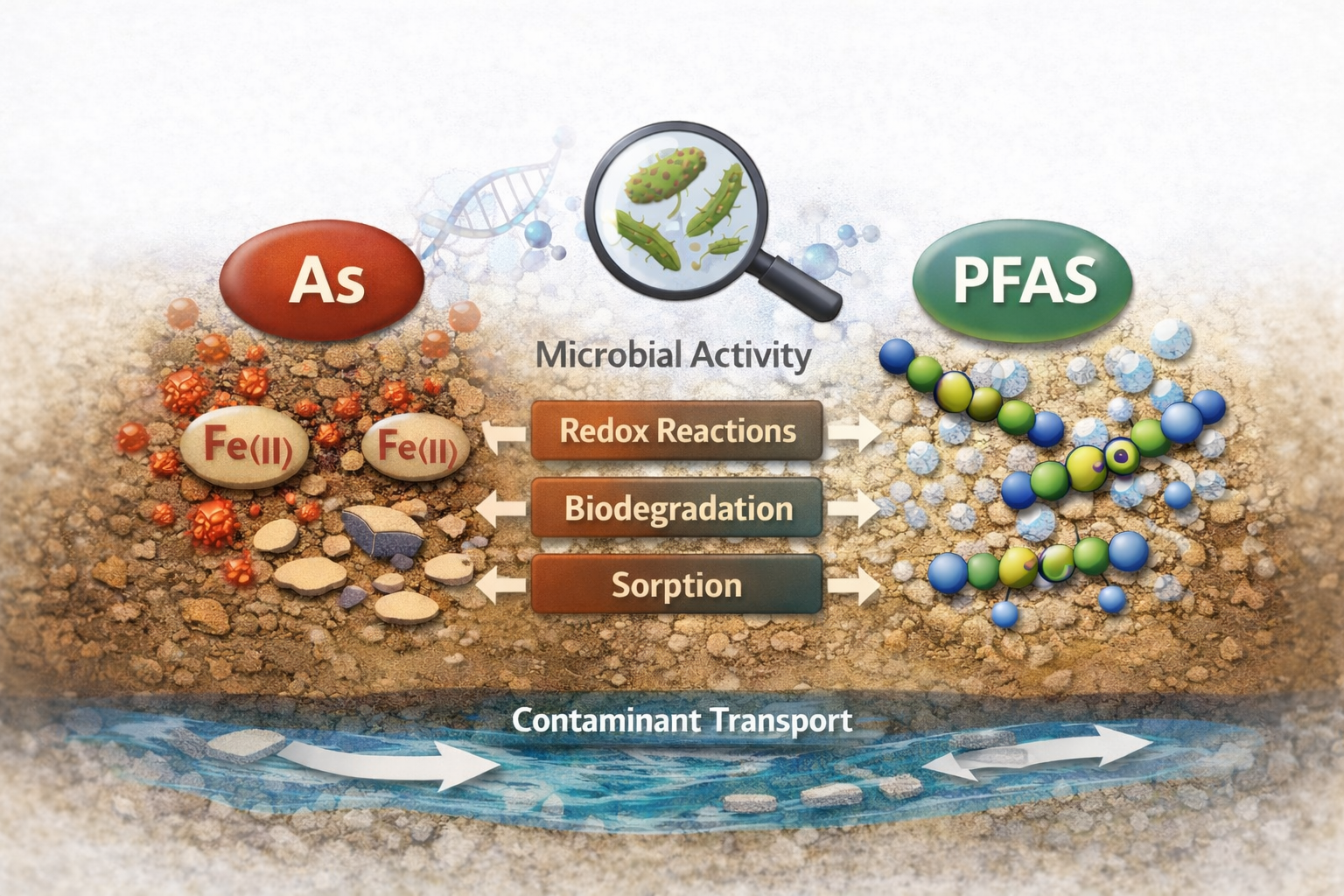
Groundwater contamination by arsenic (As) and per- and polyfluoroalkyl substances (PFAS) represents one of the most pressing environmental and public health challenges globally. While As contamination is predominantly geogenic and widespread in alluvial aquifers, PFAS contamination is largely anthropogenic, arising from industrial activities, landfill leachates, and aqueous film-forming foams (AFFF). Traditionally, scientific research has emphasized hydrogeological transport and contaminant chemistry; however, emerging evidence suggests that geomicrobiological processes play a critical role in regulating the mobility, transformation, and persistence of both contaminant classes. This emerging situation necessitates an integrated framework that explicitly links microbiology, geochemistry, and hydrology, particularly in vulnerable regions such as South Asia, including India and Bangladesh, where groundwater is the primary source of drinking water for millions of inhabitants.
Downloads
References
Chen, Y., Graziano, J. H., Parvez, F., Liu, M., Slavkovich, V., Kalra, T., Argos, M., Islam, T., Ahmed, A., Rakibuz-Zaman, M., Hasan, R., Sarwar, G., Levy, D., van Geen, A., & Ahsan, H. (2011). Arsenic exposure from drinking water and mortality from cardiovascular disease in Bangladesh: prospective cohort study. BMJ, 342, d2431–d2431. DOI: https://doi.org/10.1136/bmj.d2431
Chiriac, F. L., Stoica, C., Iftode, C., Pirvu, F., Petre, V. A., Paun, I., Pascu, L. F., Vasile, G. G., & Nita-Lazar, M. (2023). Bacterial biodegradation of perfluorooctanoic acid (PFOA) and perfluorosulfonic acid (PFOS) using pure pseudomonas strains. Sustainability, 15(18), 14000. DOI: https://doi.org/10.3390/su151814000
Dronjak, L., Mazen, K., Venkatesh, G., Moyet, M., Samara, F., & Kanan, S. (2025). Catalytic and biological degradation of poly- and perfluoroalkyl substances in water treatment: recent advances and future challenges. Discover Catalysis, 2(1). DOI: https://doi.org/10.1007/s44344-025-00020-9
Gaillard, L., Barouki, R., Blanc, E., Coumoul, X., & Andréau, K. (2025). Per- and polyfluoroalkyl substances as persistent pollutants with metabolic and endocrine-disrupting impacts. Trends in Endocrinology & Metabolism, 36(3), 249–261. DOI: https://doi.org/10.1016/j.tem.2024.07.021
Interstate Technology & Regulatory Council (ITRC). (2025). PFAS – per- and polyfluoroalkyl substances. https://pfas-1.itrcweb.org/
Jiang, Z., Li, P., Wang, Y., Liu, H., Wei, D., Yuan, C., & Wang, H. (2019). Arsenic mobilization in a high arsenic groundwater revealed by metagenomic and Geochip analyses. Scientific Reports, 9(1). DOI: https://doi.org/10.1038/s41598-019-49365-w
Kim, M. H., Wang, N., McDonald, T., & Chu, K. (2012). Biodefluorination and biotransformation of fluorotelomer alcohols by two alkane‐degrading Pseudomonas strains. Biotechnology and Bioengineering, 109(12), 3041–3048. DOI: https://doi.org/10.1002/bit.24561
Kulkarni, H. V., Mladenov, N., Datta, S., & Chatterjee, D. (2018). Influence of monsoonal recharge on arsenic and dissolved organic matter in the Holocene and Pleistocene aquifers of the Bengal Basin. Science of The Total Environment, 637–638, 588–599. DOI: https://doi.org/10.1016/j.scitotenv.2018.05.009
LeMonte, J. J., Stuckey, J. W., Sanchez, J. Z., Tappero, R., Rinklebe, J., & Sparks, D. L. (2017). Sea level rise induced arsenic release from historically contaminated coastal soils. Environmental Science & Technology, 51(11), 5913–5922. DOI: https://doi.org/10.1021/acs.est.6b06152
Maruzzo, A. J., Hernandez, A. B., Swartz, C. H., Liddie, J. M., & Schaider, L. A. (2025). Socioeconomic Disparities in Exposures to PFAS and Other Unregulated Industrial Drinking Water Contaminants in US Public Water Systems. Environmental Health Perspectives, 133(1). DOI: https://doi.org/10.1289/EHP14721
Nath, B., Chakraborty, S., Burnol, A., Stüben, D., Chatterjee, D., & Charlet, L. (2009). Mobility of arsenic in the sub-surface environment: An integrated hydrogeochemical study and sorption model of the sandy aquifer materials. Journal of Hydrology, 364(3–4), 236–248. DOI: https://doi.org/10.1016/j.jhydrol.2008.10.025
Rasmusson, K., & Fagerlund, F. (2024). Per- and polyfluoroalkyl substances (PFAS) as contaminants in groundwater resources – A comprehensive review of subsurface transport processes. Chemosphere, 362, 142663. DOI: https://doi.org/10.1016/j.chemosphere.2024.142663
Schlesinger, W. H., Klein, E. M., & Vengosh, A. (2022). The global biogeochemical cycle of arsenic. Global Biogeochemical Cycles, 36(11). DOI: https://doi.org/10.1029/2022GB007515
Verma, S., Varma, R. S., & Nadagouda, M. N. (2021). Remediation and mineralization processes for per- and polyfluoroalkyl substances (PFAS) in water: A review. Science of The Total Environment, 794, 148987. DOI: https://doi.org/10.1016/j.scitotenv.2021.148987
Wu, F., van Geen, A., Graziano, J., Ahmed, K. M., Liu, M., Argos, M., Parvez, F., Choudhury, I., Slavkovich, V. N., Ellis, T., Islam, T., Ahmed, A., Kibriya, M. G., Jasmine, F., Shahriar, M. H., Hasan, R., Shima, S. A., Sarwar, G., Navas-Acien, A., … Chen, Y. (2025b). Arsenic exposure reduction and chronic disease mortality. JAMA, 334(23), 2104. DOI: https://doi.org/10.1001/jama.2025.19161
Wu, J., Cai, Y., Xu, C., Yang, G., Zhang, H., Meng, X.-Z., Lei, J., & Zhang, S. (2025a). Co-occurrence behaviors of per- and polyfluoroalkyl substances (PFASs) and heavy metals in the groundwater of dyeing industrial sites in southern China. Ecotoxicology and Environmental Safety, 303, 118925. DOI: https://doi.org/10.1016/j.ecoenv.2025.118925
Zhang, H.-B., Wang, H.-F., Liu, J.-B., Bi, Z., Jin, R.-F., & Tian, T. (2024b). Anaerobic ammonium oxidation coupled to iron(III) reduction catalyzed by a lithoautotrophic nitrate-reducing iron(II) oxidizing enrichment culture. The ISME Journal, 18(1). DOI: https://doi.org/10.1093/ismejo/wrae149
Zhang, M., Wang, Q., Song, X., Ali, M., Tang, Z., Liu, X., Zhang, Z., Ma, S., Bi, J., & Li, Z. (2024a). Co-occurrence of per- and polyfluoroalkyl substances, heavy metals and polycyclic aromatic hydrocarbons and their composite impacts on microbial consortium in soil: A field study. Pedosphere, 34(4), 736–748. DOI: https://doi.org/10.1016/j.pedsph.2023.06.001
Zhang, Y., O’Loughlin, E. J., Park, S.-Y., & Kwon, M. J. (2023). Effects of Fe(III) (hydr)oxide mineralogy on the development of microbial communities originating from soil, surface water, groundwater, and aerosols. Science of The Total Environment, 905, 166993. DOI: https://doi.org/10.1016/j.scitotenv.2023.166993
Zhu, Y.-G., Xue, X.-M., Kappler, A., Rosen, B. P., & Meharg, A. A. (2017). Linking genes to microbial biogeochemical cycling: Lessons from arsenic. Environmental Science & Technology, 51(13), 7326–7339. DOI: https://doi.org/10.1021/acs.est.7b00689
Downloads
Published
Data Availability Statement
Not applicable.
Issue
Section
License
Copyright (c) 2026 Debashis Chatterjee, Jitendra Kewalramani, Jishnu Adhikari

This work is licensed under a Creative Commons Attribution-NonCommercial-NoDerivatives 4.0 International License.
Authors retain the copyright to their work and grant the journal and its publisher (Enviro Mind Solutions) a non-exclusive license to publish and distribute the work freely.
How to Cite