Sustainable management of chemistry laboratory wastewater in undergraduate colleges: A review and way forward
DOI:
https://doi.org/10.63697/jeshs.2025.10056Keywords:
Chemical Laboratory, Occupational Health, Environmental Pollution, Wastewater Management, SustainabilityAbstract
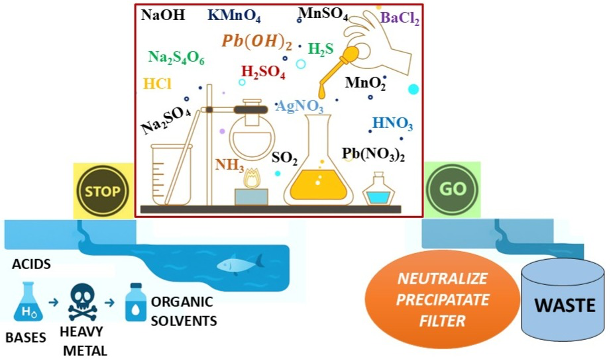
Chemistry laboratories at undergraduate colleges play a vital role in teaching and research. These laboratories produce wastewaters containing hazardous substances, including strong acids, bases, heavy metals, and organic solvents. The disposal of untreated wastewater may pose risks to the environment and human well-being. This study aims to summarize types of laboratory wastewater, disposal practices, regulatory frameworks, and emerging sustainable alternatives. The emphasis was on low-cost, sustainable, and eco-friendly treatment strategies that could be easily adopted in undergraduate colleges with limited resources. This review highlights the need to integrate sustainable wastewater management practices into academic curricula to safeguard human and environmental health, ensure regulatory compliance, and support the broader goals of environmental sustainability. The integration of microscale experiments could considerably reduce the volume of hazardous liquid effluents. Deploying small-scale, on-site treatment facilities equipped with a combination of neutralization, precipitation, and filtration methods can serve as a preliminary decontamination step before final waste management options. Strengthening well-defined protocols for waste segregation, accompanied by methodical training for faculty members, students, and laboratory attendants, can emphasize secure laboratory practices. A coordinated approach involving policy initiatives, research advancements, and educational reforms will be a key to advancing eco-friendly and sustainable laboratory waste management practices across undergraduate institutions.
Downloads
References
Abedsoltan, H., & Shiflett, M. B. (2024). Mitigation of potential risks in chemical laboratories: A focused review. ACS Chemical Health & Safety, 31(2), 104–120. DOI: https://doi.org/10.1021/acs.chas.3c00097
Adebayo, W. G. (2025). Resilience in the face of ecological challenges: Strategies for integrating environmental considerations into social policy planning in Africa. Sustainable Development, 33(1), 203–220. DOI: https://doi.org/10.1002/sd.3113
Alawa, B., Galodiya, M. N., & Chakma, S. (2022). Source reduction, recycling, disposal, and treatment. In Hazardous Waste Management (pp. 67–88). Elsevier. DOI: https://doi.org/10.1016/B978-0-12-824344-2.00005-7
Anik, A. H., Toha, M., & Tareq, S. M. (2024). Occupational chemical safety and management: A case study to identify best practices for sustainable advancement of Bangladesh. Hygiene and Environmental Health Advances, 12, 100110. DOI: https://doi.org/10.1016/j.heha.2024.100110
Ansari, A., Dutt, D., & Kumar, V. (2024). Catalyzing paradigm shifts in global waste management: A case study of Saharanpur Smart city. Waste Management Bulletin, 2(1), 29–38. DOI: https://doi.org/10.1016/j.wmb.2023.12.003
Aparcana, S. (2017). Approaches to formalization of the informal waste sector into municipal solid waste management systems in low- and middle-income countries: Review of barriers and success factors. Waste Management, 61, 593–607. DOI: https://doi.org/10.1016/j.wasman.2016.12.028
Archana, C. M., Kanakalakshmi, A., Nithya, K., Kaarunya, E., & Renugadevi, K. (2025). Health effects of emerging contaminants: Effects on humans via ingestion of contaminated water. In Emerging Contaminants and Associated Treatment Technologies (pp. 269–306). Springer Nature Switzerland. DOI: https://doi.org/10.1007/978-3-031-89591-3_9
Aubrecht, K. B., Bourgeois, M., Brush, E. J., MacKellar, J., & Wissinger, J. E. (2019). Integrating green chemistry in the curriculum: Building student skills in systems thinking, safety, and sustainability. Journal of Chemical Education, 96(12), 2872–2880. DOI: https://doi.org/10.1021/acs.jchemed.9b00354
Bai, M., Liu, Y., Qi, M., Roy, N., Shu, C.-M., Khan, F., & Zhao, D. (2022). Current status, challenges, and future directions of university laboratory safety in China. Journal of Loss Prevention in the Process Industries, 74, 104671. DOI: https://doi.org/10.1016/j.jlp.2021.104671
Baliga, M. S., D’souza, R. T., Madathil, L. P., DeSouza, R. F., Shivashankara, A. R., & Palatty, P. L. (2025). Chemicals in medical laboratory and its impact on healthcare workers and biotic factors: Analysis through the prism of environmental bioethics. Laboratories, 2(3), 14. DOI: https://doi.org/10.3390/laboratories2030014
Banks, M., Metz, M., & Smyth, D. S. (2020). The sustainability challenges facing research and teaching laboratories when going green. Environment: Science and Policy for Sustainable Development, 62(2), 4–13. DOI: https://doi.org/10.1080/00139157.2020.1708166
Bwapwa, J. K., & Bakare, B. F. (2021). Industrial wastewater treatment: Analysis and main treatment approaches. In Removal of refractory pollutants from wastewater treatment plants (pp. 13–32). https://www.taylorfrancis.com/chapters/edit/10.1201/9781003204442-2/industrial-wastewater-treatment-bwapwa-bakare DOI: https://doi.org/10.1201/9781003204442-2
Chandrappa, R., & Das, D. B. (2024). Health and safety issues. In environmental science and engineering (pp. 453–493). Springer International Publishing. DOI: https://doi.org/10.1007/978-3-031-50442-6_11
de Oliveira, D. B., Becker, R. W., Sirtori, C., & Passos, C. G. (2021). Development of environmental education concepts concerning chemical waste management and treatment: The training experience of undergraduate students. Chemistry Education Research and Practice, 22(3), 653–661. DOI: https://doi.org/10.1039/D0RP00170H
Debrah, J. K., Teye, G. K., & Dinis, M. A. P. (2022). Barriers and challenges to waste management hindering the circular economy in Sub-Saharan Africa. Urban Science, 6(3), 57. DOI: https://doi.org/10.3390/urbansci6030057
Dhenkula, S. P., Shende, A. D., Deshpande, L., & Pophali, G. R. (2025). Removal of heavy metals from laboratory waste liquid (LWL) generated from water and wastewater analytical laboratories. Process Safety and Environmental Protection, 200, 107336. DOI: https://doi.org/10.1016/j.psep.2025.107336
Freese, T., Elzinga, N., Heinemann, M., Lerch, M. M., & Feringa, B. L. (2024). The relevance of sustainable laboratory practices. RSC Sustainability, 2(5), 1300–1336. DOI: https://doi.org/10.1039/D4SU00056K
Gericke, N., Högström, P., & Wallin, J. (2023). A systematic review of research on laboratory work in secondary school. Studies in Science Education, 59(2), 245–285. DOI: https://doi.org/10.1080/03057267.2022.2090125
Goh, H. Y., Wong, W. W. C., & Ong, Y. Y. (2019). A study to reduce chemical waste generated in chemistry teaching laboratories. Journal of Chemical Education, 97(1), 87–96. DOI: https://doi.org/10.1021/acs.jchemed.9b00632
Gupta, J., Ghosh, P., Kumari, M., Thakur, I. S., & Swati. (2022). Solid waste landfill sites for the mitigation of greenhouse gases. In Biomass, Biofuels, Biochemicals (pp. 315–340). Elsevier. DOI: https://doi.org/10.1016/B978-0-12-823500-3.00010-8
Hashim, M., Tabassum, B., Khan, T., Khan, M., Hasan, A., & Khan, N. (2025). Managing hazardous industrial waste: Effective treatment and disposal approaches. In Sustainable Landscape Planning and Natural Resources Management (pp. 69–86). Springer Nature Switzerland. DOI: https://doi.org/10.1007/978-3-031-80845-6_7
Hassan, M. R., Khan, M. F., Mahmud, M. S., & Samad, A. (2025). Potential factors affecting watershed deterioration: A critical review. Water, Air, & Soil Pollution, 236(9), 607. DOI: https://doi.org/10.1007/s11270-025-08260-z
Ho, C. -C., & Chen, M. -S. (2018). Risk assessment and quality improvement of liquid waste management in Taiwan University chemical laboratories. Waste Management, 71, 578–588. DOI: https://doi.org/10.1016/j.wasman.2017.09.029
Huang, H., Xie, X., Xiao, F., Liu, B., Zhang, T., Feng, F., Lan, B., & Zhang, C. (2024). A critical review of deep oxidation of gaseous volatile organic compounds via aqueous advanced oxidation processes. Environmental Science & Technology, 58(42), 18456–18473. DOI: https://doi.org/10.1021/acs.est.4c07202
Hussein, B. A., & Shifera, G. (2022). Knowledge, attitude, and practice of teachers and laboratory technicians toward chemistry laboratory safety in secondary schools. Journal of Chemical Education, 99(9), 3096–3103. DOI: https://doi.org/10.1021/acs.jchemed.2c00043
Jain, R., Srivastava, A., Yadav, M., & Sharma, R. K. (2021). Green chemistry in education, practice, and teaching. In Green Chemistry for Beginners (pp. 263–282). Jenny Stanford Publishing. DOI: https://doi.org/10.1201/9781003180425-7
Jakubčinová, J., Feszterová, M., & Silliková, V. (2024). Active learning in the extraction of organic compounds: A study of undergraduate chemistry students. Education Sciences, 14(10), 1051. DOI: https://doi.org/10.3390/educsci14101051
Jan, I., Ahmad, T., Wani, M. S., Dar, S. A., Wani, N. A., Malik, N. A., & Tantary, Y. R. (2022). Threats and consequences of untreated wastewater on freshwater environments. In Microbial Consortium and Biotransformation for Pollution Decontamination (pp. 1–26). Elsevier. DOI: https://doi.org/10.1016/B978-0-323-91893-0.00009-2
Jing, G., Meng, X., Sun, W., Kowalczuk, P. B., & Gao, Z. (2023). Recent advances in the treatment and recycling of mineral processing wastewater. Environmental Science: Water Research & Technology, 9(5), 1290–1304. DOI: https://doi.org/10.1039/D2EW00944G
Kala, K., & Bolia, N. B. (2024). Empowering the informal sector in urban waste management: Towards a comprehensive waste management policy for India. Environmental Development, 49, 100968. DOI: https://doi.org/10.1016/j.envdev.2024.100968
Kandel, K. P., Neupane, B. B., & Giri, B. (2017). Status of chemistry lab safety in Nepal. PLOS One, 12(6), e0179104. DOI: https://doi.org/10.1371/journal.pone.0179104
Kihampa, C., & Hellar-Kihampa, H. (2015). Environmental and public health risks associated with chemical waste from research and educational laboratories in Dar es Salaam, Tanzania. Journal of Chemical Health & Safety, 22(6), 19–25. DOI: https://doi.org/10.1016/j.jchas.2015.01.015
King, D. C. P., Watts, M. J., Hamilton, E. M., Mortimer, R., Kilgour, D. P. A., & Di Bonito, M. (2023). The present and potential future of aqueous mercury preservation: A review. Environmental Science: Processes & Impacts, 25(3), 351–363. DOI: https://doi.org/10.1039/D2EM00409G
Milo, A., Chen, L., Grice, K. A., & Vosburg, D. A. (2025). Alternatives to dichloromethane for teaching laboratories. Journal of Chemical Education, 102(6), 2261–2267. DOI: https://doi.org/10.1021/acs.jchemed.5c00106
Nandi, S., & Swain, S. (2024). Role of groundwater systems in fulfilling sustainable development goals: A focus on SDG6 and SDG13. Current Opinion in Environmental Science & Health, 42, 100576. DOI: https://doi.org/10.1016/j.coesh.2024.100576
Neelam, Hajam, Y. A., & Kumar, R. (2025). Biomedical waste: Sources, characterization, color-coding, segregation, transportation, and disposal methods. In Biomedical Waste Management (pp. 21–60). Apple Academic Press. DOI: https://doi.org/10.1201/9781003595434-2
Nidheesh, P. V., Couras, C., Karim, A. V., & Nadais, H. (2022). A review of integrated advanced oxidation processes and biological processes for organic pollutant removal. Chemical Engineering Communications, 209(3), 390–432. DOI: https://doi.org/10.1080/00986445.2020.1864626
Nurullah, A. B. M., Khatun, M. S., & Ritchie, L. (2025). Industrial wastewater disposal and its socio-environmental consequences: Evidence from the Uttara export processing zone, Bangladesh. Sustainability, 17(17), 7716. DOI: https://doi.org/10.3390/su17177716
O’Neil, N. J., Scott, S., Relph, R., & Ponnusamy, E. (2020). Approaches to incorporating green chemistry and safety into laboratory culture. Journal of Chemical Education, 98(1), 84–91. DOI: https://doi.org/10.1021/acs.jchemed.0c00134
Oros, A. (2025). Bioaccumulation and trophic transfer of heavy metals in marine fish: Ecological and ecosystem-level impacts. Journal of Xenobiotics, 15(2), 59. DOI: https://doi.org/10.3390/jox15020059
Phifer, R. (2024). The subtleties of managing laboratory waste in 2024. ACS Chemical Health & Safety, 31(6), 521–525. DOI: https://doi.org/10.1021/acs.chas.4c00047
Ramm, J. G., Dorscheid, G. L., Passos, Camila. G., & Sirtori, C. (2018). Development of a waste management program in technical chemistry teaching. Journal of Chemical Education, 95(4), 570–576. DOI: https://doi.org/10.1021/acs.jchemed.7b00590
Rezai, B., & Allahkarami, E. (2021). Wastewater treatment processes—techniques, technologies, challenges faced, and alternative solutions. In Soft Computing Techniques in Solid Waste and Wastewater Management (pp. 35–53). Elsevier. DOI: https://doi.org/10.1016/B978-0-12-824463-0.00004-5
Rim, K.-T., & Lim, C.-H. (2014). Biologically hazardous agents at work and efforts to protect workers’ health: A review of recent reports. Safety and Health at Work, 5(2), 43–52. DOI: https://doi.org/10.1016/j.shaw.2014.03.006
Roy, M., Pathak, V. K., & Sharma, R. (2025). Policies and legislative framework for industrial wastewater management. In Integrated Biotechnological Solutions for the Treatment of Industrial Wastewater (pp. 527–557). Elsevier. DOI: https://doi.org/10.1016/B978-0-443-23607-5.00009-X
Shahzadi, S., Fatima, S., ul ain, Q., Shafiq, Z., & Janjua, M. R. S. A. (2025). A review on green synthesis of silver nanoparticles (SNPs) using plant extracts: A multifaceted approach in photocatalysis, environmental remediation, and biomedicine. RSC Advances, 15(5), 3858–3903. DOI: https://doi.org/10.1039/D4RA07519F
Sharma, A., Grewal, A. S., Sharma, D., & Srivastav, A. L. (2023). Heavy metal contamination in water: Consequences on human health and environment. In Metals in Water (pp. 39–52). Elsevier. DOI: https://doi.org/10.1016/B978-0-323-95919-3.00015-X
Sharma, N., Kumar, R., Vihari, N. S., Arora, M., & Saini, J. R. (2025). Prioritizing smart city themes for multi-national enterprises and United Nations sustainable development goals. Sustainability, 17(10), 4251. DOI: https://doi.org/10.3390/su17104251
Thakur, R., Joshi, V., Sahoo, G. C., Jindal, N., Tiwari, R. R., & Rana, S. (2025). Review of mechanisms and impacts of nanoplastic toxicity in aquatic organisms and potential impacts on human health. Toxicology Reports, 14, 102013. DOI: https://doi.org/10.1016/j.toxrep.2025.102013
Tripathy, S., Kar, O. P., & Pradhan, A. (2025). Challenges and innovations in industrial wastewater treatment: Safeguarding water resources and promoting sustainable practices. Water, Air, & Soil Pollution, 236(2), 92. DOI: https://doi.org/10.1007/s11270-025-07742-4
Tunç, M., & Solmaz, R. (2025). Occupational health and safety assessment of hydrogen transport by trucks. International Journal of Hydrogen Energy, 144, 851–859. DOI: https://doi.org/10.1016/j.ijhydene.2025.05.073
Varshney, R., Singh, P., & Yadav, D. (2022). Hazardous wastes treatment, storage, and disposal facilities. In Hazardous Waste Management (pp. 33–64). Elsevier. DOI: https://doi.org/10.1016/B978-0-12-824344-2.00009-4
Verma, G., Mondal, K., Islam, M., & Gupta, A. (2024). Recent advances in advanced micro and nanomanufacturing for wastewater purification. ACS Applied Engineering Materials, 2(2), 262–285. DOI: https://doi.org/10.1021/acsaenm.3c00711
Wang, L., Ma, L., Wang, J., Zhao, X., Jing, Y., Liu, C., Xiao, Y., Li, C., Jiao, C., & Xu, M. (2024). Research progress on the removal of contaminants from wastewater by constructed wetland substrate: A review. Water, 16(13), 1848. DOI: https://doi.org/10.3390/w16131848
Wu, Y.-S., Osman, A. I., Hosny, M., Elgarahy, A. M., Eltaweil, A. S., Rooney, D. W., Chen, Z., Rahim, N. S., Sekar, M., Gopinath, S. C. B., Mat Rani, N. N. I., Batumalaie, K., & Yap, P.-S. (2024). The toxicity of mercury and its chemical compounds: Molecular mechanisms and environmental and human health implications: A comprehensive review. ACS Omega, 9(5), 5100–5126. DOI: https://doi.org/10.1021/acsomega.3c07047
Downloads
Published
Data Availability Statement
This is a review article, and the data are publicly available as published materials cited in this manuscript.
Issue
Section
License
Copyright (c) 2026 Amit Kumar Kundu, Md Habib, Manirul Mandal

This work is licensed under a Creative Commons Attribution-NonCommercial-NoDerivatives 4.0 International License.
Authors retain the copyright to their work and grant the journal and its publisher (Enviro Mind Solutions) a non-exclusive license to publish and distribute the work freely.
How to Cite