Continental–Himalayan controls on shifting temperature extremes: A spatiotemporal assessment of heat and cold days in northern Bangladesh
DOI:
https://doi.org/10.63697/jeshs.2026.10072Keywords:
Extreme Heat, Extreme Cold, Continental–Himalayan Controls, Climate Change, Northern BangladeshAbstract
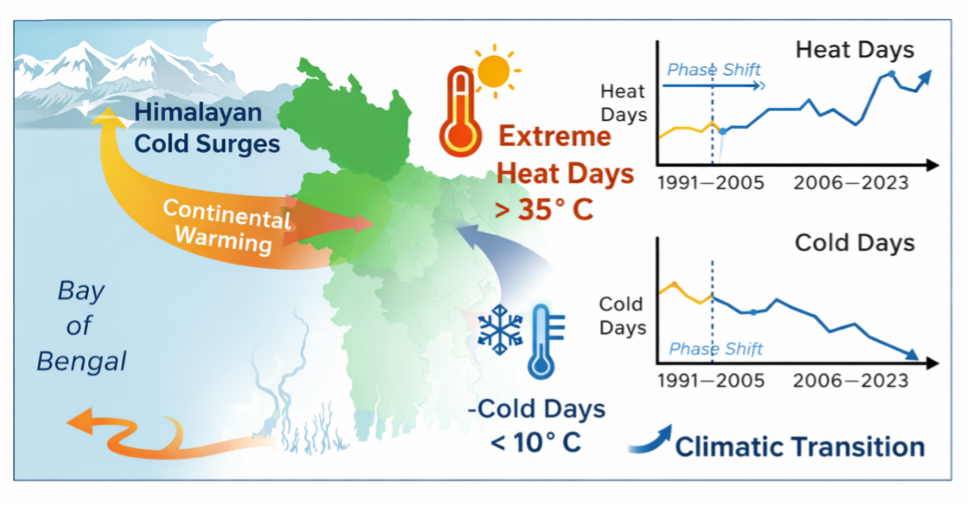
Understanding shifts in temperature extremes is crucial for agricultural planning and long-term climate adaptation in climatically sensitive regions. This study analyzes daily temperature data from northern Bangladesh (1991–2023) to assess changes in extreme heat (>35°C) and cold (<10°C) days, a region influenced by continentality and limited maritime moderation. After data quality control, trends were evaluated using the modified Mann–Kendall test, and shifts were detected using the Pettitt method. The findings indicate two distinct phases: from 1991 to 2005, cold extremes declined sharply due to weakened Himalayan cold surges, whereas heat extremes showed neutral to slightly negative trends. After 2006, all stations exhibited strong increases in heat days (τ = 2.88–3.49), driven by intensified continental warming and reduced pre-monsoon moisture inflow. Cold-day frequencies remained low, confirming persistent winter warming. Overall, the region is transitioning toward a hotter and less thermally variable climate, requiring targeted adaptation strategies.
Downloads
References
Abdullah, A. Y. M., Bhuian, M. H., Kiselev, G., Dewan, A., Hassan, Q. K., & Rafiuddin, M. (2021). Extreme temperature and rainfall events in Bangladesh: A comparison between coastal and inland areas. International Journal of Climatology, 42(6), 3253–3273. DOI: https://doi.org/10.1002/joc.6911
Almazroui, M. (2020). Changes in temperature trends and extremes over Saudi Arabia for the period 1978–2019. Advances in Meteorology, 2020, 1–21. DOI: https://doi.org/10.1155/2020/8828421
Anand, B., Karunanidhi, D., Subramani, T., Srinivasamoorthy, K., & Suresh, M. (2020). Long-term trend detection and spatiotemporal analysis of groundwater levels using GIS techniques in Lower Bhavani River basin, Tamil Nadu, India. Environment, Development and Sustainability, 22(4), 2779–2800. DOI: https://doi.org/10.1007/s10668-019-00318-3
Bhattacharjee, S., Naja, M., Jaiswal, A., Rawat, K. S., Sagar, R., & Ananthakrishnan, S. (2022). ARIES ST Radar: The first Central Himalayan wind profiler. Journal of Astronomical Instrumentation, 11(04). DOI: https://doi.org/10.1142/S2251171722400050
Chowdhury, M. R., & Ndiaye, O. (2017). Climate change and variability impacts on the forests of Bangladesh – a diagnostic discussion based on CMIP5 GCMs and ENSO. International Journal of Climatology, 37(14), 4768–4782. DOI: https://doi.org/10.1002/joc.5120
Costa, R. L., Macedo de Mello Baptista, G., Gomes, H. B., Daniel dos Santos Silva, F., Lins da Rocha Júnior, R., de Araújo Salvador, M., & Herdies, D. L. (2020). Analysis of climate extremes indices over northeast Brazil from 1961 to 2014. Weather and Climate Extremes, 28, 100254. DOI: https://doi.org/10.1016/j.wace.2020.100254
Easterling, D. R., Kunkel, K. E., Wehner, M. F., & Sun, L. (2016). Detection and attribution of climate extremes in the observed record. Weather and Climate Extremes, 11, 17–27. DOI: https://doi.org/10.1016/j.wace.2016.01.001
Ehsan, M. A., Tippett, M. K., Robertson, A. W., Singh, B., & Rahman, M. A. (2023). The ENSO fingerprint on Bangladesh summer monsoon rainfall. Earth Systems and Environment, 7(3), 617–627. DOI: https://doi.org/10.1007/s41748-023-00347-z
Fahad, M. G. R., Saiful Islam, A. K. M., Nazari, R., Alfi Hasan, M., Tarekul Islam, G. M., & Bala, S. K. (2018). Regional changes of precipitation and temperature over Bangladesh using bias‐corrected multi‐model ensemble projections considering high‐emission pathways. International Journal of Climatology, 38(4), 1634–1648. DOI: https://doi.org/10.1002/joc.5284
Ghiami-Shamami, F., Sabziparvar, A. A., & Shinoda, S. (2018). Long-term comparison of the climate extremes variability in different climate types located in coastal and inland regions of Iran. Theoretical and Applied Climatology, 136(3–4), 875–897. DOI: https://doi.org/10.1007/s00704-018-2523-4
Girma, A., Qin, T., Wang, H., Yan, D., Gedefaw, M., Abiyu, A., & Batsuren, D. (2020). Study on recent trends of climate variability using innovative trend analysis: The case of the upper Huai River Basin. Polish Journal of Environmental Studies, 29(3), 2199–2210. DOI: https://doi.org/10.15244/pjoes/103448
Grubbs, F. E. (1950). Sample criteria for testing outlying observations. The Annals of Mathematical Statistics, 21(1), 27–58. DOI: https://doi.org/10.1214/aoms/1177729885
Hussain, A., Cao, J., Hussain, I., Begum, S., Akhtar, M., Wu, X., Guan, Y., & Zhou, J. (2021). Observed trends and variability of temperature and precipitation and their global teleconnections in the Upper Indus Basin, Hindukush-Karakoram-Himalaya. Atmosphere, 12(8), 973. DOI: https://doi.org/10.3390/atmos12080973
Immerzeel, W. (2008). Historical trends and future predictions of climate variability in the Brahmaputra basin. International Journal of Climatology, 28(2), 243–254. DOI: https://doi.org/10.1002/joc.1528
Intergovernmental Panel on Climate Change (IPCC). (2023). Climate Change 2021 – The Physical Science Basis. Cambridge University Press. DOI: https://doi.org/10.1017/9781009157896
Islam, A. R. M. T., Rahman, M. S., Khatun, R., & Hu, Z. (2020a). Spatiotemporal trends in the frequency of daily rainfall in Bangladesh during 1975–2017. Theoretical and Applied Climatology, 141(3–4), 869–887. DOI: https://doi.org/10.1007/s00704-020-03244-x
Islam, A. R. M. T., Shill, B. K., Salam, R., Siddik, M. N. A., & Patwary, M. A. (2021). Insight into farmers’ agricultural adaptive strategy to climate change in northern Bangladesh. Environment, Development and Sustainability, 23(2), 2439–2464. DOI: https://doi.org/10.1007/s10668-020-00681-6
Khan, M. J. U., Islam, A. K. M. S., Das, M. K., Mohammed, K., Bala, S. K., & Islam, G. M. T. (2019). Observed trends in climate extremes over Bangladesh from 1981 to 2010. Climate Research, 77(1), 45–61. DOI: https://doi.org/10.3354/cr01539
Krämer, W. (2011). Durbin–Watson Test. In International Encyclopedia of Statistical Science (pp. 408–409). Springer Berlin Heidelberg. DOI: https://doi.org/10.1007/978-3-642-04898-2_219
Kumar, N., Yadav, B. P., Gahlot, S., & Singh, M. (2015). Winter frequency of western disturbances and precipitation indices over Himachal Pradesh, India: 1977-2007. Atmósfera, 28(1), 63–70. DOI: https://doi.org/10.20937/ATM.2015.28.01.06
Kumar, P., & Sarthi, P. P. (2019). Surface temperature evaluation and future projections over India using CMIP5 models. Pure and Applied Geophysics, 176(11), 5177–5201. DOI: https://doi.org/10.1007/s00024-019-02203-6
Mallick, J., Islam, A. R. Md. T., Ghose, B., Islam, H. M. T., Rana, Y., Hu, Z., Bhat, S. A., Pal, S. C., & Ismail, Z. B. (2022). Spatiotemporal trends of temperature extremes in Bangladesh under changing climate using multi-statistical techniques. Theoretical and Applied Climatology, 147(1–2), 307–324. DOI: https://doi.org/10.1007/s00704-021-03828-1
Manabe, S., Stouffer, R. J., Spelman, M. J., & Bryan, K. (1991). Transient responses of a coupled ocean–atmosphere model to gradual changes of atmospheric CO2. Part I. Annual mean response. Journal of Climate, 4(8), 785–818. DOI: https://doi.org/10.1175/1520-0442(1991)004<0785:TROACO>2.0.CO;2
Monir, M. M., Rokonuzzaman, M., Sarker, S. C., Alam, E., Islam, M. K., & Islam, A. R. M. T. (2023). Spatiotemporal analysis and predicting rainfall trends in a tropical monsoon-dominated country using MAKESENS and machine learning techniques. Scientific Reports, 13(1). DOI: https://doi.org/10.1038/s41598-023-41132-2
Monir, M. M., Sarker, S. C., Rahman, M. M., & Islam, M. N. (2026). Analysis of the trend of dry spells and how ocean factors affect their patterns during the summer monsoon in Bangladesh using the Mann-Kendall and frontier atmospheric general circulation model. Geosystems and Geoenvironment, 5(2), 100472. DOI: https://doi.org/10.1016/j.geogeo.2025.100472
Nie, Y., Sun, Y., Zhang, X., & Chen, G. (2025). Human-induced changes in extreme cold surges across the Northern Hemisphere. Nature Communications, 16(1). DOI: https://doi.org/10.1038/s41467-025-62576-2
Oliveira, P. T., Santos e Silva, C. M., & Lima, K. C. (2016). Climatology and trend analysis of extreme precipitation in subregions of Northeast Brazil. Theoretical and Applied Climatology, 130(1–2), 77–90. DOI: https://doi.org/10.1007/s00704-016-1865-z
Rahman, Md. R., & Lateh, H. (2017). Climate change in Bangladesh: a spatio-temporal analysis and simulation of recent temperature and rainfall data using GIS and time series analysis model. Theoretical and Applied Climatology, 128(1–2), 27–41. DOI: https://doi.org/10.1007/s00704-015-1688-3
Rajib, M. A., Mortuza, M. R., Selmi, S., Ankur, A. K., Rahman, M. M. 2011. Increase of heat index over Bangladesh: Impact of climate change. World Academy of Science, Engineering and Technology, 58, 402–405.
Rawat, K. S., Sahu, S. R., Singh, S. K., & Mishra, A. K. (2022). Cloudburst analysis in the Nainital district, Himalayan Region, 2021. Discover Water, 2(1). DOI: https://doi.org/10.1007/s43832-022-00020-y
Roxy, M. K., Ritika, K., Terray, P., Murtugudde, R., Ashok, K., & Goswami, B. N. (2015). Drying of Indian subcontinent by rapid Indian Ocean warming and a weakening land-sea thermal gradient. Nature Communications, 6(1). DOI: https://doi.org/10.1038/ncomms8423
Roy, S. S., & Balling, R. C., Jr. (2005). Analysis of trends in maximum and minimum temperature, diurnal temperature range, and cloud cover over India. Geophysical Research Letters, 32(12). DOI: https://doi.org/10.1029/2004GL022201
Russo, S., Dosio, A., Graversen, R. G., Sillmann, J., Carrao, H., Dunbar, M. B., Singleton, A., Montagna, P., Barbola, P., & Vogt, J. V. (2014). Magnitude of extreme heat waves in present climate and their projection in a warming world. Journal of Geophysical Research: Atmospheres, 119(22), 12500–12512. DOI: https://doi.org/10.1002/2014JD022098
Schweikert, A., Chinowsky, P., Espinet, X., & Tarbert, M. (2014). Climate Change and Infrastructure Impacts: Comparing the Impact on Roads in ten Countries through 2100. Procedia Engineering, 78, 306–316. DOI: https://doi.org/10.1016/j.proeng.2014.07.072
Tabassum, A., Park, K., Shin, J., Jin, H. -G., & Baik, J. -J. (2023). Long-term changes in temperature, specific humidity, and precipitation in Bangladesh revealed by ERA5 data. Theoretical and Applied Climatology, 155(3), 1915–1925. DOI: https://doi.org/10.1007/s00704-023-04732-6
Ullah, S., You, Q., Ullah, W., & Ali, A. (2018). Observed changes in precipitation in China-Pakistan economic corridor during 1980–2016. Atmospheric Research, 210, 1–14. DOI: https://doi.org/10.1016/j.atmosres.2018.04.007
von Neumann, J. (1941). Distribution of the ratio of the mean square successive difference to the variance. The Annals of Mathematical Statistics, 12(4), 367–395. DOI: https://doi.org/10.1214/aoms/1177731677
Widiputra, H. (2015). Nearest neighbour approach with non-parametric regression analysis for multiple time-series modelling and predictions. International Journal of Business Intelligence and Data Mining, 10(3), 253–279. DOI: https://doi.org/10.1504/IJBIDM.2015.071326
Yuan, Y., Santamouris, M., Xu, D., Geng, X., Li, C., Cheng, W., Su, L., Xiong, P., Fan, Z., Wang, X., & Liao, C. (2025). Surface urban heat island effects intensify more rapidly in lower income countries. Npj Urban Sustainability, 5(1). DOI: https://doi.org/10.1038/s42949-025-00198-9
Zhang, S., & Lu, X. X. (2009). Hydrological responses to precipitation variation and diverse human activities in a mountainous tributary of the lower Xijiang, China. CATENA, 77(2), 130–142. DOI: https://doi.org/10.1016/j.catena.2008.09.001
Zhang, X., Hegerl, G., Zwiers, F. W., & Kenyon, J. (2005). Avoiding inhomogeneity in percentile-based indices of temperature extremes. Journal of Climate, 18(11), 1641–1651. DOI: https://doi.org/10.1175/JCLI3366.1
Zhang, Y., Li, Q., Ge, Y., Du, X., & Wang, H. (2022). Growing prevalence of heat over cold extremes with overall milder extremes and multiple successive events. Communications Earth & Environment, 3(1), 73. DOI: https://doi.org/10.1038/s43247-022-00404-x
Downloads
Published
Data Availability Statement
The data will be made available upon request from the corresponding author.
Issue
Section
License
Copyright (c) 2026 Md. Moniruzzaman Monir, Shapla Akhter

This work is licensed under a Creative Commons Attribution-NonCommercial-NoDerivatives 4.0 International License.
Authors retain the copyright to their work and grant the journal and its publisher (Enviro Mind Solutions) a non-exclusive license to publish and distribute the work freely.
How to Cite