Phthalic acid esters and polybrominated diphenyl occurrence in a coastal lagoon: Spatial patterns, trends and potential risk
DOI:
https://doi.org/10.63697/jeshs.2026.10059Keywords:
Emerging contaminants, Plastic wastes, Coastal waters, Ecotoxicological risk, NigeriaAbstract
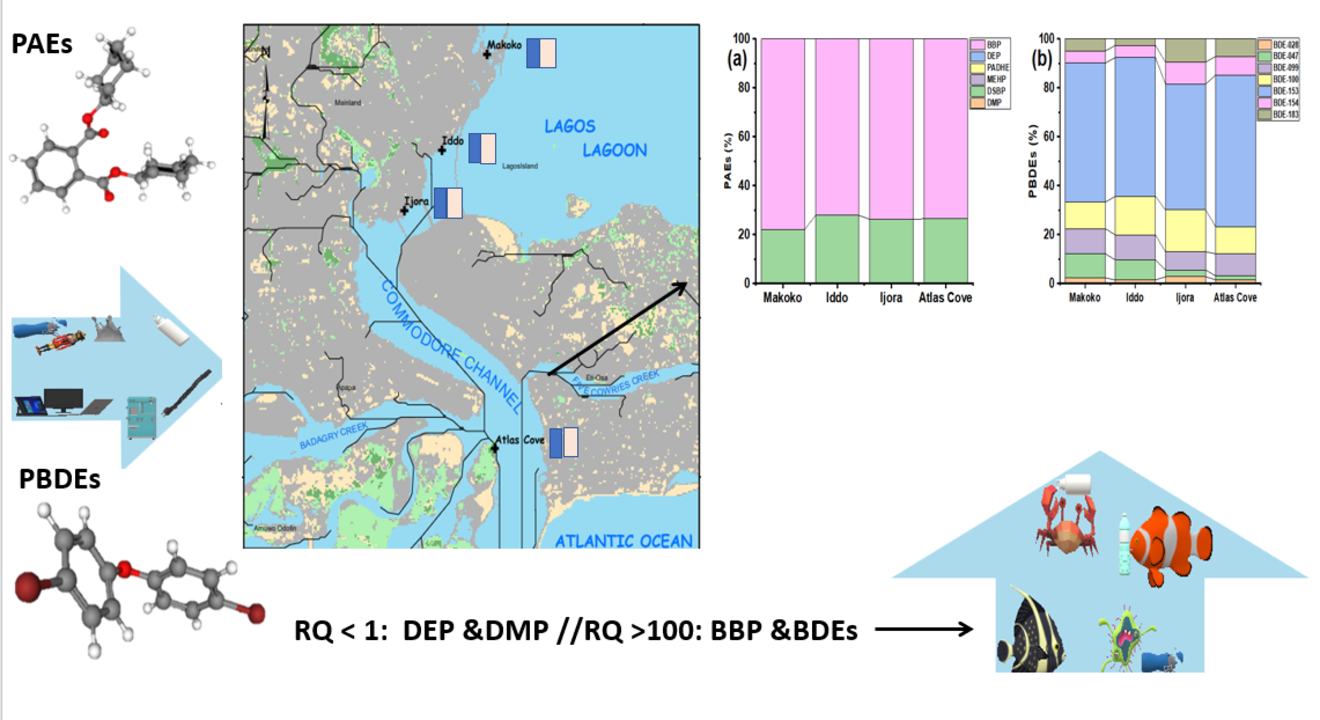
Phthalate esters (PAEs) and polybrominated diphenyl ethers (PBDEs) are emerging contaminants whose bioaccumulative potential pose serious risks to ecosystems and human health. This study assessed the concentrations, distribution, and ecological risks of PAE and PBDE congeners in surface water and sediment from four selected catchments along the Lagos Lagoon, Nigeria. Extraction of target compounds was performed using liquid–liquid and ultrasonication techniques, followed by gas chromatography mass spectrometry (GC–MS) analysis. All examined PBDE congeners and two of the six targeted PAEs, di-sec-butyl phthalate (DSBP) and benzyl butyl phthalate (BBP) were detected in all sampling locations and matrices. In contrast, diethyl phthalate (DEP) and phthalic acid decyl hept-2-yl ester (PADHE) was detected in few sites. Mean concentrations of PAEs ranged from 0.39–0.52 mg/L in surface water and 0.33–0.57 mg/kg in sediment, while mean PBDE concentration ranged from 0.047–0.11 mg/L and 0.06–0.21 mg/kg in surface water and sediment, respectively. Benzyl butyl phthalate contributed 73.48% of total PAEs in surface water and 73.07% in sediment, whereas 2,2',4,4',5,5'-hexabromodiphenyl ether (BDE-153) accounted for 55.14% of total PBDEs in surface water and 34.75% in sediment. Principal component analysis (PCA) revealed a dominance of low molecular weight PAEs: dimethyl phthalate (DMP) and high-brominated PBDEs commonly linked to domestic effluents, urban runoff, plastic based materials, and consumer products indicating intense human activities especially at Makoko and Atlas Cove. Risk quotient (RQ) indicates low risk (RQ < 1) from DEP and DMP, whereas levels of BBP suggest the potential for significant ecological risk (RQ > 100), especially on algae in most locations. Detected PBDE concentrations with RQs ≥ 100, likely resulting from the debromination of heavily brominated deca-BDEs, suggest considerable risk to aquatic biota. Notably, the elevated levels of hexa- and hepta-BDE congeners at Makoko and Atlas Cove indicate potential adverse effects on aquatic organisms. These findings highlight the need for stringent regulatory measures and informed management actions, to safeguard Nigeria’s coastal environments and public health.
Downloads
References
Abdus-Salam, N., Adekola, F. A., & Apata, A. O. (2010). A physicochemical assessment of water quality of oil producing areas of Ilaje, Nigeria. Advances in Natural and Applied Sciences, 333+. https://link.gale.com/apps/doc/A252944808/AONE?u=anon~2b820738&sid=googleScholar&xid=30b0f2eb
Adedayo, A., Adeyemi, D., Uyimandu, J. P., Chigome, S., & Anyakora, C. (2012). Evaluation of the levels of polycyclic aromatic hydrocarbons in surface and bottom waters of Lagos Lagoon, Nigeria. African Journal of Pharmaceutical Sciences and Pharmacy, 3(1), 58–74.
Adegunwa, A. O., Ore, O. T., Tayo, A. S., & Adebiyi, F. M. (2024). Occurrence, source identification and risk assessment of polybrominated diphenyl ethers in water and sediments of Osun River, Nigeria. BMC Environmental Science, 1(1), 6. DOI: https://doi.org/10.1186/s44329-024-00006-2
Adeniyi, A. A., Okedeyi, O. O., & Yusuf, K. A. (2011). Flame ionization gas chromatographic determination of phthalate esters in water, surface sediments and fish species in the Ogun river catchments, Ketu, Lagos, Nigeria. Environmental Monitoring and Assessment, 172(1–4), 561–569. DOI: https://doi.org/10.1007/s10661-010-1354-2
Adeogun, A. O., Ibor, O. R., Omogbemi, E. D., Chukwuka, A. V., Adegbola, R. A., Adewuyi, G. A., & Arukwe, A. (2015). Environmental occurrence and biota concentration of phthalate esters in Epe and Lagos Lagoons, Nigeria. Marine Environmental Research, 108, 24–32. DOI: https://doi.org/10.1016/j.marenvres.2015.04.002
Adewuyi, G. O., & Adeleye, A. (2013). Evaluation of polybrominated diphenyl ethers in sediment of Lagos Lagoon, Nigeria. African Journal of Environmental Science and Technology, 7(7), 686–693.
Adeyi, A. A., Olayanju, B., & Osibanjo, O. (2017). Distribution and levels of polybrominated diethyl ethers (PBDEs) in sediment and biota of Lagos Lagoon, Nigeria. Organohalogen Compounds, 79, 612–615.
Alani, R., Olayinka, K., & Alo, B. (2013). Studies on persistent organic pollutants (POPs) in the Lagos Lagoon 1: occurrence and levels of polycyclic aromatic hydrocarbons (PAHs) in surface waters of the lagoon. Journal of Emerging Trends in Engineering and Applied Sciences, 4(6), 811–818.
Amir, S., Hafidi, M., Merlina, G., Hamdi, H., Jouraiphy, A., El Gharous, M., & Revel, J. C. (2005). Fate of phthalic acid esters during composting of both lagooning and activated sludges. Process Biochemistry, 40(6), 2183–2190. DOI: https://doi.org/10.1016/j.procbio.2004.08.012
Annamalai, J., & Vasudevan, N. (2020). Detection of phthalate esters in PET bottled drinks and lake water using esterase/PANI/CNT/CuNP based electrochemical biosensor. Analytica Chimica Acta, 1135, 175–186. DOI: https://doi.org/10.1016/j.aca.2020.09.041
Barnhoorn, I. E. J., Bornman, M. S., Pieterse, G. M., & van Vuren, J. H. J. (2004). Histological evidence of intersex in feral sharptooth catfish (Clarias gariepinus) from an estrogen‐polluted water source in Gauteng, South Africa. Environmental Toxicology, 19(6), 603–608. DOI: https://doi.org/10.1002/tox.20068
De Boer, J. (2009). Brominated Flame Retardants in the Environment. In NATO Science for Peace and Security Series C: Environmental Security (pp. 3–14). Springer Netherlands. DOI: https://doi.org/10.1007/978-90-481-2903-4_1
Bridson, J. H., Gaugler, E. C., Smith, D. A., Northcott, G. L., & Gaw, S. (2021). Leaching and extraction of additives from plastic pollution to inform environmental risk: A multidisciplinary review of analytical approaches. Journal of Hazardous Materials, 414, 125571. DOI: https://doi.org/10.1016/j.jhazmat.2021.125571
Cao, X. (2010). Phthalate esters in foods: Sources, occurrence, and analytical methods. Comprehensive Reviews in Food Science and Food Safety, 9(1), 21–43. DOI: https://doi.org/10.1111/j.1541-4337.2009.00093.x
Carmalin, S. A., & Lima, E. C. (2018). Removal of emerging contaminants from the environment by adsorption. Ecotoxicology and Environmental Safety, 150, 1–17. DOI: https://doi.org/10.1016/j.ecoenv.2017.12.026
Chai, M., Ding, H., Shen, X., & Li, R. (2019). Contamination and ecological risk of polybrominated diphenyl ethers (PBDEs) in surface sediments of mangrove wetlands: A nationwide study in China. Environmental Pollution, 249, 992–1001. DOI: https://doi.org/10.1016/j.envpol.2019.02.044
Coffin, M. R. S., Courtenay, S. C., Pater, C. C., & van den Heuvel, M. R. (2018). An empirical model using dissolved oxygen as an indicator for eutrophication at a regional scale. Marine Pollution Bulletin, 133, 261–270. DOI: https://doi.org/10.1016/j.marpolbul.2018.05.041
Daniel, N. I., & Joshua Ibrahim, M. (2024). Spatiotemporal variations of rainfall over Nigeria from 1971 to 2020. International Journal of Research and Innovation in Social Science, 8(7), 1374–1390. DOI: https://doi.org/10.47772/IJRISS.2024.807115
Deng, H., Li, R., Yan, B., Li, B., Chen, Q., Hu, H., Xu, Y., & Shi, H. (2021). PAEs and PBDEs in plastic fragments and wetland sediments in Yangtze estuary. Journal of Hazardous Materials, 409, 124937. DOI: https://doi.org/10.1016/j.jhazmat.2020.124937
Dueñas-Moreno, J., Vázquez-Tapia, I., Mora, A., Cervantes-Avilés, P., Mahlknecht, J., Capparelli, M. V., Kumar, M., & Wang, C. (2024). Occurrence, ecological and health risk assessment of phthalates in a polluted urban river used for agricultural land irrigation in central Mexico. Environmental Research, 240, 117454. DOI: https://doi.org/10.1016/j.envres.2023.117454
EC (2003). Technical Guidance Document on Risk Assessment (EUR 20418 EN). European Chemicals Bureau, Institute for Health and Consumer Protection, European Commission. https://op.europa.eu/en/publication-detail/-/publication/212940b8-3e55-43f8-8448-ba258d0374bb?
Edjere, O., Asibor, I. G., & Otolo, S. E. (2016). Evaluation of the levels of phthalate ester plasticizers in surface water of Ethiope River System, Delta State, Nigeria. Journal of Applied Sciences and Environmental Management, 20(3), 608–614. DOI: https://doi.org/10.4314/jasem.v20i3.15
Emmanuel, B. E., & Chukwu, L. O. (2010). Spatial distribution of saline water and possible sources of intrusion into a tropical freshwater lagoon and the transitional effects on the lacustrine ichthyofaunal diversity. African Journal of Environmental Science and Technology, 4(7), 480–491.
Environment Canada. 2013. Canadian Environmental Protection Act, 1999. Federal Environmental Quality Guidelines: Polybrominated Diphenyl Ethers (PBDEs). https://www.canada.ca/content/dam/eccc/migration/ese-ees/05df7a37-60ff-403f-bb37-0cc697dbd9a3/feqg_pbde_en.pdf
Fagbemi, J. O., Oyekunle, J. A. O., Ogunfowokan, A. O., Cheng, F., & Deobald, L. (2024). Phthalate esters in water and sediment of Asunle stream of Obafemi Awolowo University, Ile-Ife, Nigeria: Distribution and human health risks. Heliyon, 10(14), e34748. DOI: https://doi.org/10.1016/j.heliyon.2024.e34748
Fortune, Plastic Additives Market Size, Growth & Forecast Report [2028], F.B. Insights. USA. 2022. Available online: https://www.fortunebusinessinsights.com/plastic-additivesmarket-104448 (accessed on 17 March 2023).
Fu, J., Zhang, H., Li, R., Shi, T., Wang, L., Cheng, G., Huang, J., Li, S., Gao, H., Jin, S., & Na, G. (2023). Spatial distribution, source, and ecological risk of polybrominated diphenyl ethers (PBDEs) and hexabromocyclododecanes (HBCDs) in Jiaozhou Bay, China. Marine Pollution Bulletin, 192, 114978. DOI: https://doi.org/10.1016/j.marpolbul.2023.114978
Gao, D.-W., & Wen, Z.-D. (2016). Phthalate esters in the environment: A critical review of their occurrence, biodegradation, and removal during wastewater treatment processes. Science of The Total Environment, 541, 986–1001. DOI: https://doi.org/10.1016/j.scitotenv.2015.09.148
Grieshaber, C. A., Penland, T. N., Kwak, T. J., Cope, W. G., Heise, R. J., Law, J. M., Shea, D., Aday, D. D., Rice, J. A., & Kullman, S. W. (2018). Relation of contaminants to fish intersex in riverine sport fishes. Science of The Total Environment, 643, 73–89. DOI: https://doi.org/10.1016/j.scitotenv.2018.06.071
Groh, K. J., Backhaus, T., Carney-Almroth, B., Geueke, B., Inostroza, P. A., Lennquist, A., Leslie, H. A., Maffini, M., Slunge, D., Trasande, L., Warhurst, A. M., & Muncke, J. (2019). Overview of known plastic packaging-associated chemicals and their hazards. Science of The Total Environment, 651, 3253–3268. DOI: https://doi.org/10.1016/j.scitotenv.2018.10.015
Gunaalan, K., Fabbri, E., & Capolupo, M. (2020). The hidden threat of plastic leachates: A critical review on their impacts on aquatic organisms. Water Research, 184, 116170. DOI: https://doi.org/10.1016/j.watres.2020.116170
Hahladakis, J. N., Velis, C. A., Weber, R., Iacovidou, E., & Purnell, P. (2018). An overview of chemical additives present in plastics: Migration, release, fate and environmental impact during their use, disposal and recycling. Journal of Hazardous Materials, 344, 179–199. DOI: https://doi.org/10.1016/j.jhazmat.2017.10.014
Heo, H., Choi, M.-J., Park, J., Nam, T., & Cho, J. (2020). Anthropogenic Occurrence of Phthalate Esters in Beach Seawater in the Southeast Coast Region, South Korea. Water, 12(1), 122. DOI: https://doi.org/10.3390/w12010122
Hermabessiere, L., Dehaut, A., Paul-Pont, I., Lacroix, C., Jezequel, R., Soudant, P., & Duflos, G. (2017). Occurrence and effects of plastic additives on marine environments and organisms: A review. Chemosphere, 182, 781–793. DOI: https://doi.org/10.1016/j.chemosphere.2017.05.096
Hu, G., Dai, J., Xu, Z., Luo, X., Cao, H., Wang, J., Mai, B., & Xu, M. (2010). Bioaccumulation behavior of polybrominated diphenyl ethers (PBDEs) in the freshwater food chain of Baiyangdian Lake, North China. Environment International, 36(4), 309–315. DOI: https://doi.org/10.1016/j.envint.2010.01.002
Ighalo, J. O., Kurniawan, S. B., Iwuozor, K. O., Aniagor, C. O., Ajala, O. J., Oba, S. N., Iwuchukwu, F. U., Ahmadi, S., & Igwegbe, C. A. (2022). A review of treatment technologies for the mitigation of the toxic environmental effects of acid mine drainage (AMD). Process Safety and Environmental Protection, 157, 37–58. DOI: https://doi.org/10.1016/j.psep.2021.11.008
Katsikantami, I., Sifakis, S., Tzatzarakis, M. N., Vakonaki, E., Kalantzi, O.-I., Tsatsakis, A. M., & Rizos, A. K. (2016). A global assessment of phthalates burden and related links to health effects. Environment International, 97, 212–236. DOI: https://doi.org/10.1016/j.envint.2016.09.013
Kingsley, O., & Witthayawirasak, B. (2020). Occurrence, ecological and health risk assessment of phthalate esters in surface water of U-Tapao Canal, Southern, Thailand. Toxics, 8(3), 58. DOI: https://doi.org/10.3390/toxics8030058
Li, R., Liang, J., Gong, Z., Zhang, N., & Duan, H. (2017). Occurrence, spatial distribution, historical trend and ecological risk of phthalate esters in the Jiulong River, Southeast China. Science of The Total Environment, 580, 388–397. DOI: https://doi.org/10.1016/j.scitotenv.2016.11.190
Liu, B., Jiang, T., Li, Z., Ge, W., Wu, J., Song, N., & Chai, C. (2021). Phthalate esters in surface sediments from fishing ports in Circum-Bohai-Sea region, China. Marine Pollution Bulletin, 171, 112782. DOI: https://doi.org/10.1016/j.marpolbul.2021.112782
Liu, J., Lu, G., Zhang, F., Nkoom, M., Yan, Z., & Wu, D. (2018). Polybrominated Diphenyl Ethers (PBDEs) in a Large, Highly Polluted Freshwater Lake, China: Occurrence, Fate, and Risk Assessment. International Journal of Environmental Research and Public Health, 15(7), 1529. DOI: https://doi.org/10.3390/ijerph15071529
Liu, H., Cui, K., Zeng, F., Chen, L., Cheng, Y., Li, H., Li, S., Zhou, X., Zhu, F., Ouyang, G., Luan, T., & Zeng, Z. (2014). Occurrence and distribution of phthalate esters in riverine sediments from the Pearl River Delta region, South China. Marine Pollution Bulletin, 83(1), 358–365. DOI: https://doi.org/10.1016/j.marpolbul.2014.03.038
Long, E. R. (2006). Calculation and uses of mean sediment quality guideline quotients: A critical review. Environmental Science & Technology, 40(6), 1726–1736. DOI: https://doi.org/10.1021/es058012d
Maceira, A., Borrull, F., & Marcé, R. M. (2019). Occurrence of plastic additives in outdoor air particulate matters from two industrial parks of Tarragona, Spain: Human inhalation intake risk assessment. Journal of Hazardous Materials, 373, 649–659. DOI: https://doi.org/10.1016/j.jhazmat.2019.04.014
Mackintosh, C. E., Maldonado, J., Hongwu, J., Hoover, N., Chong, A., Ikonomou, M. G., & Gobas, F. A. P. C. (2004). Distribution of phthalate esters in a marine aquatic food web: Comparison to polychlorinated biphenyls. Environmental Science & Technology, 38(7), 2011–2020. DOI: https://doi.org/10.1021/es034745r
Marandi, A., Polikarpus, M., & Jõeleht, A. (2013). A new approach for describing the relationship between electrical conductivity and major anion concentration in natural waters. Applied Geochemistry, 38, 103–109. DOI: https://doi.org/10.1016/j.apgeochem.2013.09.003
Murhekar Gopalkrushna, H. (2011). Assessment of physico-chemical status of ground water samples in Akot city. Research Journal of Chemical Sciences, 1(4), 117–124.
Net, S., Delmont, A., Sempéré, R., Paluselli, A., & Ouddane, B. (2015). Reliable quantification of phthalates in environmental matrices (air, water, sludge, sediment and soil): A review. Science of The Total Environment, 515–516, 162–180. DOI: https://doi.org/10.1016/j.scitotenv.2015.02.013
Obiakara-Amaechi, A. I., Abayomi, A. A., Olorunfemi, T. A., & Chukwu, L. O. (2025). Characterization and ecological risk assessment of microplastics in sediments of a tropical West African Lagoon ecosystem. Journal of Environmental Science, Health & Sustainability, 1(2), 85–101. DOI: https://doi.org/10.63697/jeshs.2025.10034
Okoro, H. K., Orosun, M. M., Abdulmojeed, M., Iwuozor, K. O., Popoola, S. A., Emenike, E. C., Zvinowanda, C., & Ngila, J. C. (2024). Ecological risk assessment and phthalate ester concentrations in sediment samples from Ilorin metropolis, North Central Nigeria. Regional Studies in Marine Science, 72, 103444. DOI: https://doi.org/10.1016/j.rsma.2024.103444
Oladejo, O. H., Nubi, A. O., Adesina, R., Oyatola, O. O., & Bassey, B. O. (2022). Assessment of polybrominated diphenyl ethers (PBDEs) level and physico-chemical characteristics of water and sediment of Gulf of Guinea. Earthline Journal of Chemical Sciences, 97–114. DOI: https://doi.org/10.34198/ejcs.8122.97114
Olaniyan, O. O., Adeniji, A. O., Okoh, A. I., & Okoh, O. O. (2024). Occurrence and risk assessment of polybrominated diphenyl ethers in surficial water and sediment from Buffalo River estuary, South Africa. Marine Pollution Bulletin, 209, 117176. DOI: https://doi.org/10.1016/j.marpolbul.2024.117176
Olarinmoye, O. M., Stock, F., Scherf, N., Whenu, O., Asenime, C., & Ganzallo, S. (2020). Microplastic presence in sediment and water of a lagoon bordering the urban agglomeration of Lagos, Southwest Nigeria. Geosciences, 10(12), 494. DOI: https://doi.org/10.3390/geosciences10120494
Olutona, G. O., Oyekunle, J. A. O., Ogunfowokan, A. O., & Fatoki, O. S. (2016). Assessment of polybrominated diphenyl ethers in sediment of Asunle stream of the Obafemi Awolowo University, Ile-Ife, Nigeria. Environmental Science and Pollution Research, 23(21), 21195–21205. DOI: https://doi.org/10.1007/s11356-016-7270-4
Omuku, P. E., Odidika, C. C., Ozukwe, A. E., & Iwuozor, K. O. (2022). A comparative evaluation of rain water obtained from corrugated roofing sheets within Awka Metropolis, Anambra State. Iranian Journal of Energy and Environment, 13(2), 134–140. DOI: https://doi.org/10.5829/IJEE.2022.13.02.04
Oyeleke, P. O., Olatunde Popoola, S., & Ayoola Abiodun, O. (2019). Assessment of some physico-chemical parameters of Lagos Lagoon, Southwestern Nigeria. Academic Journal of Chemistry, 4(3), 09–11. DOI: https://doi.org/10.32861/ajc.43.09.11
Ramzi, A., Gireeshkumar, T. R., Habeeb Rahman, K., Balachandran, K. K., Shameem, K., Chacko, J., & Chandramohanakumar, N. (2020). Phthalic acid esters – A grave ecological hazard in Cochin estuary, India. Marine Pollution Bulletin, 152, 110899. DOI: https://doi.org/10.1016/j.marpolbul.2020.110899
Ramzi, A., Gireeshkumar, T. R., Habeeb Rahman, K., Manu, M., Balachandran, K. K., Chacko, J., & Chandramohanakumar, N. (2018). Distribution and contamination status of phthalic acid esters in the sediments of a tropical monsoonal estuary, Cochin – India. Chemosphere, 210, 232–238. DOI: https://doi.org/10.1016/j.chemosphere.2018.06.182
Scholz, S., & Mayer, I. (2008). Molecular biomarkers of endocrine disruption in small model fish. Molecular and Cellular Endocrinology, 293(1–2), 57–70. DOI: https://doi.org/10.1016/j.mce.2008.06.008
Seyoum, A., & Pradhan, A. (2019). Effect of phthalates on development, reproduction, fat metabolism and lifespan in Daphnia magna. Science of The Total Environment, 654, 969–977. DOI: https://doi.org/10.1016/j.scitotenv.2018.11.158
Shao, Y., Han, S., Ma, L., Luo, M., Yang, G., Liu, W., & Xu, D. (2018). Polybrominated diphenyl ethers in surface waters around Beijing: Occurrence, distribution and sources. Applied Geochemistry, 98, 58–64. DOI: https://doi.org/10.1016/j.apgeochem.2018.09.011
Stockholm Convention Clearing House, n.d. https://chm.pops.int/default.aspx
Umulor, S. O., Obanya, H. E., Amaeze, N. H., & Okoroafor, C. U. (2018). Levels, spatial and seasonal distribution of polybrominated diphenyl ethers (PBDEs) in water, sediments and sarotherodon melanotheron from Ologe Lagoon. Asian Journal of Environment and Ecology, 8(1), 1–13. DOI: https://doi.org/10.9734/AJEE/2018/45308
USEPA (1984). Method 8270: Semivolatile organic compounds by gas chromatography/mass spectrometry (SW-846). U.S. Environmental Protection Agency. (EPA Report No. SW-846).
USEPA (2012). 2012 TRIData Summary. https://19january2021snapshot.epa.gov/toxics-release-inventory-tri-program/2012-tri-national-analysis-materials_.html
Usese, A. I., Chukwu, L. O., Naidu, R., Islam, S., & Rahman, M. M. (2020). Arsenic fractionation in sediments and speciation in muscles of fish, Chrysichthys nigrodigitatus from a contaminated tropical Lagoon, Nigeria. Chemosphere, 256, 127134. DOI: https://doi.org/10.1016/j.chemosphere.2020.127134
Walkley, A., Black, I.A., 1934. An examination of the Degtjareff method for determining soil organic matter, and a proposed modification of the chromic acid titration method. Soil science, 37, 29–38. DOI: https://doi.org/10.1097/00010694-193401000-00003
Wang, F., Xiang, L., Sze-Yin Leung, K., Elsner, M., Zhang, Y., Guo, Y., Pan, B., Sun, H., An, T., Ying, G., Brooks, B. W., Hou, D., Helbling, D. E., Sun, J., Qiu, H., Vogel, T. M., Zhang, W., Gao, Y., Simpson, M. J., … Tiedje, J. M. (2024). Emerging contaminants: A One Health perspective. The Innovation, 5(4), 100612. DOI: https://doi.org/10.1016/j.xinn.2024.100612
Wang, X.-T., Chen, L., Wang, X.-K., Zhang, Y., Zhou, J., Xu, S.-Y., Sun, Y.-F., & Wu, M.-H. (2015). Occurrence, profiles, and ecological risks of polybrominated diphenyl ethers (PBDEs) in river sediments of Shanghai, China. Chemosphere, 133, 22–30. DOI: https://doi.org/10.1016/j.chemosphere.2015.02.064
Wang, Y., Zhu, H., & Kannan, K. (2019). A review of biomonitoring of phthalate exposures. Toxics, 7(2), 21. DOI: https://doi.org/10.3390/toxics7020021
Wormuth, M., Scheringer, M., Vollenweider, M., & Hungerbühler, K. (2006). What are the sources of exposure to eight frequently used phthalic acid esters in Europeans? Risk Analysis, 26(3), 803–824. DOI: https://doi.org/10.1111/j.1539-6924.2006.00770.x
Zhang, K., Su, J., Xiong, X., Wu, X., Wu, C., & Liu, J. (2016). Microplastic pollution of lakeshore sediments from remote lakes in Tibet plateau, China. Environmental Pollution, 219, 450–455. DOI: https://doi.org/10.1016/j.envpol.2016.05.048
Downloads
Published
Data Availability Statement
The data will be made available upon request from the corresponding author.
Issue
Section
License
Copyright (c) 2026 Amii Isaac Obiakara-Amaechi, Akeem Akindele Abayomi, Lawal Ololade Ipadeola, Labeebah Damilola Dhikrullah, Olugbenga Bolupe Oguntowo, Lucian Obinna Chukwu

This work is licensed under a Creative Commons Attribution-NonCommercial-NoDerivatives 4.0 International License.
Authors retain the copyright to their work and grant the journal and its publisher (Enviro Mind Solutions) a non-exclusive license to publish and distribute the work freely.
How to Cite