Relevance of PFAS (per- and polyfluoroalkyl substances) contamination to the environment and sustainable development
DOI:
https://doi.org/10.63697/jeshs.2025.10065Keywords:
Per- and polyfluoroalkyl substances (PFAS), Forever chemicals, Eternal pollutants, Health effects of PFAS, PFAS removalAbstract
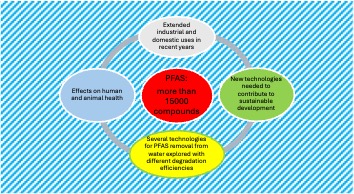
Following the objective of the Journal of Environmental Science, Health & Sustainability to provide a dedicated platform to report important environmental problems, this editorial aims to motivate the readers to stay aware of the dramatic situation represented by per- and polyfluoroalkyl substances (PFAS) and how they are related to sustainable development. PFAS are a large and complex class of synthetic chemicals that have been extensively used in consumer products globally since the 1950s. These molecules have a chain of linked carbon and fluorine atoms, and, due to the high strength of the C-F bonds, they do not degrade and are environmentally persistent. For these reasons, humans and animals are exposed to these compounds, causing multiple health effects, and these “forever chemicals” have been declared priority pollutants. PFAS interfere with Sustainable Development Goals because they undermine goals related to clean water, good health, and sustainable ecosystems. They contaminate water and soil, harming wildlife and human health by potentially causing reproductive and developmental issues, increased cancer risk, and immune system suppression. Addressing this requires phasing out non-essential uses and developing solutions for decontamination and sustainable water management. In this sense, several technologies have been attempted to degrade these persistent and toxic pollutants from water, achieving different efficiencies. The PFAS chemical structure, applications, effects on human health, and some remediation solutions are mentioned in this editorial with the objective of relating these aspects to sustainable development.
Downloads
References
Alalm, M.G., Boffito, D.C., 2022. Mechanisms and pathways of PFAS degradation by advanced oxidation and reduction processes: a critical review. Chemical Engineering Journal, 450, 138352. DOI: https://doi.org/10.1016/j.cej.2022.138352
Ameduri, B., 2025. What do we know about per- or polyfluoroalkyl substances (PFASs)? Issues, challenges, regulations, and possible alternatives. Macromolecules, 58, 2781−2791. DOI: https://doi.org/10.1021/acs.macromol.4c02993
Birch, Q.T., Birch, M.E., Nadagouda, M.N., Dionysiou, D.D., 2022. Nano-enhanced treatment of per-fluorinated and poly-fluorinated alkyl substances (PFAS). Current Opinion in Chemical Engineering, 35, 100779. DOI: https://doi.org/10.1016/j.coche.2021.100779
Blake, B.E., Fenton, S.E., 2020. Early life exposure to per- and polyfluoroalkyl substances (PFAS) and latent health outcomes: A review including the placenta as a target tissue and possible driver of peri- and postnatal effects. Toxicology, 443, 152565. DOI: https://doi.org/10.1016/j.tox.2020.152565
EPA, 2025. Per- and Polyfluoroalkyl Substances (PFAS). Final PFAS National Primary Drinking Water Regulation. https://www.epa.gov/sdwa/and-polyfluoroalkyl-substances-pfas (accessed on September 2025).
Esfahani, B., Zeidabadi, F.A., Rajesh, L., McBeath, S.T., Mohseni, M., 2024. A mini-review on advanced reduction processes for per-and polyfluoroalkyl substances remediation: current status and future prospects. Current Opinion in Chemical Engineering, 44, 101018. DOI: https://doi.org/10.1016/j.coche.2024.101018
Fang, J., Li, S., Qiu, R., Zhang, W-x., 2024. “Forever chemicals”: a sticky environmental problem. Frontiers of Environmental Science and Engineering, 18, 131. DOI: https://doi.org/10.1007/s11783-024-1891-5
Gomri, C., Benkhaled, B.T., Cretin, M., Semsarilar, M., 2024. Adsorbent material used for the treatment of per- and poly-fluoroalkyl substances (PFAS): A short review. Macromolecular Chemistry and Physics, 225, 2400012. DOI: https://doi.org/10.1002/macp.202400012
Guo, W., Hao, W., Xiao, W., 2025. Emerging perfluorinated chemical GenX: Environmental and biological fates and risks. Environment and Health, 3, 338–351. DOI: https://doi.org/10.1021/envhealth.4c00164
Häubi, R.B., Turuban, P., 2025. PFAS regulation: ‘forever chemical’ banned under global treaty, Swissinfo.ch. https://www.swissinfo.ch/eng/international-geneva/geneva-breakthrough-forever-chemical-banned-under-global-treaty/89279639 (accessed on June 2025).
Leung S.C.E., Shukla, P., Chen, D., Eftekhari, E., An, H., Zare, F., Ghasemi, N., Zhang, D., Nguyen, N.T., Li, Q., 2022. Emerging technologies for PFOS/PFOA degradation and removal: A review. Science of the Total Environment, 827, 153669. DOI: https://doi.org/10.1016/j.scitotenv.2022.153669
Litter, M.I., 2018. The story and future of nanoparticulated iron materials, In: Litter, M.I., Quici, N., Meichtry, M., editors. Iron nanomaterials for water and soil treatment. Pan Stanford Publishing Pte. Ltd., Singapore, pp. 1–16. DOI: https://doi.org/10.1201/b22501-1
Litter, M.I., 2025. Use of materials containing zerovalent iron nanoparticles for PFAS removal from water: a critical review. Environmental Science: Water Research & Technology, submitted. DOI: https://doi.org/10.1039/D5EW00743G
Ma, D., Olivares, C.I., 2025. Perfluoroalkane sulfonamides and derivatives, a different class of PFAS: Sorption and microbial biotransformation insights. Environmental Science & Technology, 59, 10734−10749. DOI: https://doi.org/10.1021/acs.est.5c00906
Moghadasi, R., Mumberg, T., Wanner, P., 2023. Spatial prediction of concentrations of per- and polyfluoroalkyl substances (PFAS) in European soils. Environmental Science & Technology Letters, 10(11), 1125–1129. DOI: https://doi.org/10.1021/acs.estlett.3c00633
National Institute of Environmental Health Science (NIEHS), 2025. Perfluoroalkyl and polyfluoroalkyl substances (PFAS), https://www.niehs.nih.gov/health/topics/agents/pfc (accessed on June 2025).
Ohoro, C.R., Amaku, J.F., Conradie, J., Olisah, C., Akpomie, K.G., Malloum, A., Akpotu, S.O., Adegoke, K.A., Okeke, E.S., Omotola, E.O., 2024. Effect of physicochemical parameters on the occurrence of per- and polyfluoroalkyl substances (PFAS) in aquatic environment. Marine Pollution Bulletin, 208, 117040. DOI: https://doi.org/10.1016/j.marpolbul.2024.117040
Pasinszki, T., Krebsz, M., 2020. Synthesis and application of zero-valent iron nanoparticles in water treatment, environmental remediation, catalysis, and their biological effects. Nanomaterials, 10, 917. DOI: https://doi.org/10.3390/nano10050917
Qian, L., Georgi, A., Gonzalez-Olmos, R., Kopinke, F.D., 2020. Degradation of perfluorooctanoic acid adsorbed on Fe-zeolites with molecular oxygen as oxidant under UV-A irradiation. Applied Catalysis B: Environmental, 278, 119283. DOI: https://doi.org/10.1016/j.apcatb.2020.119283
Racz, L., Kempisty, D.M., 2021. In: Kempisty, D.M., Racz, L., editors. PFAS today and tomorrow. In: Forever Chemicals. Environmental, economic, and social equity concerns with PFAS, in the environment, Boca Raton, CRC Press; USA, p. 3. DOI: https://doi.org/10.1201/9781003024521-2
Schrenk, D., Bignami, M., Bodin, L., et al., 2020. Risk to human health related to the presence of perfluoroalkyl substances in food. EFSA Journal, 18, 6223, 391 pp. DOI: https://doi.org/10.2903/j.efsa.2020.6223
Tshangana, C.S., Nhlengethwa, S.T., Glass, S., Denison, S., Kuvarega, A.T., Nkambule, T.T.I., Mamba, B.B., Alvarez, P.J.J., Muleja, A.A., 2025. Technology status to treat PFAS contaminated water and limiting factors for their effective full-scale application. NPJ Clean Water, 8, 41. DOI: https://doi.org/10.1038/s41545-025-00457-3
United Nations, The Sustainable Development Goals Report 2025. https://unstats.un.org/sdgs/report/2025/ (accessed on November 2025).
US EPA, 2006. 2010/15 PFOA Stewardship Program. US EPA (United State Environmental Protection Agency). Environmental Working Group PP – United States of America.
Verma, S., Varma, R.S., Nadagouda, M.N., 2021. Remediation and mineralization processes for per- and polyfluoroalkyl substances (PFAS) in water: A review. Science of the Total Environment, 794, 148987. DOI: https://doi.org/10.1016/j.scitotenv.2021.148987
Wang, X., Qiu, L., Chen, Z., Chen, H., Wang, J., Zhang, Y., Xu, Y., Kong, D., Zhang, M., Gu, C., 2025. New insights into the reductive destruction of per- and polyfluoroalkyl substances in hydrated electron-based systems. Environmental Science & Technology, 59, 5786−5795. DOI: https://doi.org/10.1021/acs.est.4c08548
Wen, J., Li, H., Ottosen, L.D.M., Lundqvist, J., Vergeynst, L., 2023. Comparison of the photocatalytic degradability of PFOA, PFOS and GenX using Fe-zeolite in water. Chemosphere, 344, 140344. DOI: https://doi.org/10.1016/j.chemosphere.2023.140344
Yadav, M., Osonga, F.J., Sadik, O.A., 2024. Unveiling nano-empowered catalytic mechanisms for PFAS sensing, removal and destruction in water. Science of the Total Environment, 912, 169279. DOI: https://doi.org/10.1016/j.scitotenv.2023.169279
Yin, S., Villagrán, D., 2022. Design of nanomaterials for the removal of per- and poly-fluoroalkyl substances (PFAS) in water: Strategies, mechanisms, challenges, and opportunities. Science of the Total Environment, 831, 154939. DOI: https://doi.org/10.1016/j.scitotenv.2022.154939
Downloads
Published
Data Availability Statement
Not applicable.
Issue
Section
License
Copyright (c) 2025 Marta I. Litter

This work is licensed under a Creative Commons Attribution-NonCommercial-NoDerivatives 4.0 International License.
Authors retain the copyright to their work and grant the journal and its publisher (Enviro Mind Solutions) a non-exclusive license to publish and distribute the work freely.
How to Cite