Linking economy, agro-food land use, and groundwater management to greenhouse gas emissions in Bangladesh
DOI:
https://doi.org/10.63697/jeshs.2026.10085Keywords:
Climate change, Energy-food-water nexus, Greenhouse gas emission, Sustainability, Policy and frameworkAbstract
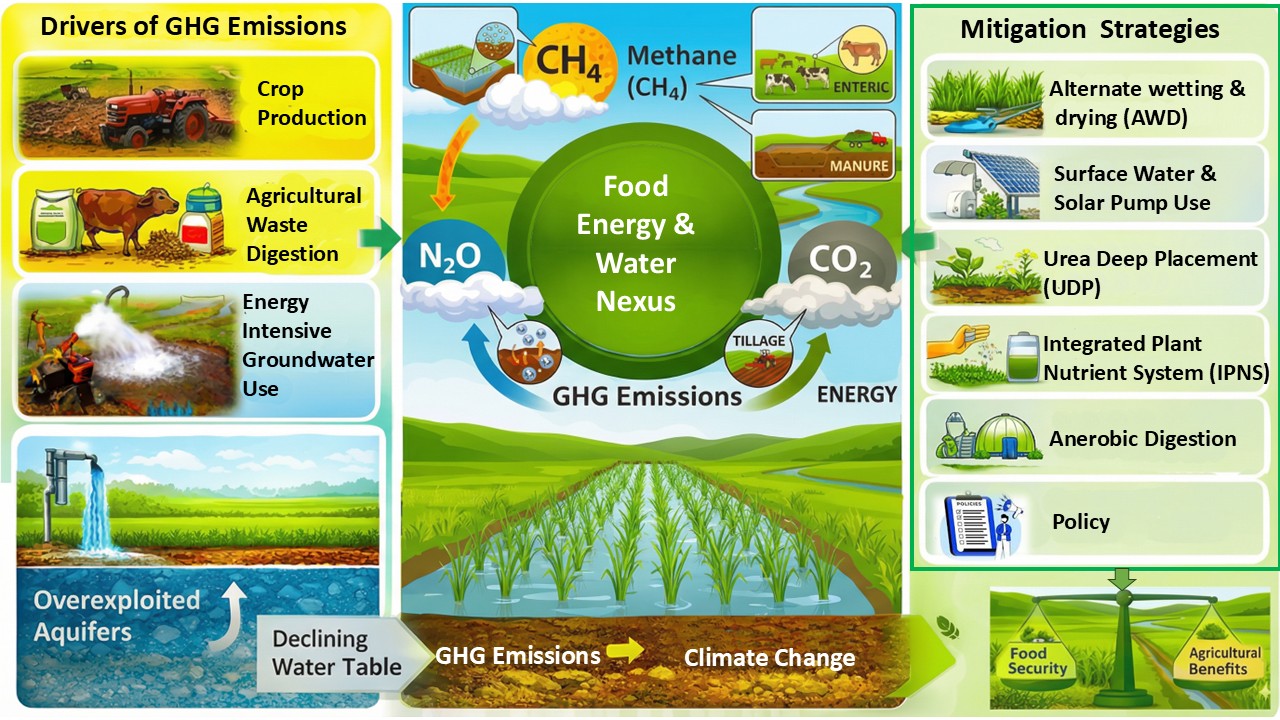
The agricultural sector in Bangladesh is a significant contributor to greenhouse gas (GHG) emissions, driven by intensive crop production, irrigation-dependent groundwater extraction, and associated energy use. At the same time, high-input agriculture remains essential for food security and economic growth, creating a critical sustainability challenge. This study provides an integrated overview linking Bangladesh’s economic context, agri-food land use, and groundwater management to GHG emissions. Based on a synthesis of peer-reviewed literature, national statistics, and international datasets, the review examined how dry-season irrigation—largely dependent on diesel and electricity-powered groundwater pumping—drives energy demand and emissions. The analysis highlights the influence of climatic variability and geographic conditions on emission patterns, with methane (CH4), nitrous oxide (N2O), and carbon dioxide (CO2) identified as the dominant gases from agricultural activities. The review further evaluates mitigation options, including alternate wetting and drying (AWD), surface water use, solar irrigation, prilled urea utilization (PU), urea deep placement (UDP), integrated plant nutrient system (IPNS), and anaerobic digestion. Existing policy frameworks and groundwater management practices are also assessed. The findings underscore the need to better integrate groundwater management with low-carbon agricultural practices to reduce emissions while sustaining productivity under climate change in Bangladesh.
Downloads
References
ADB, 2014. Bangladesh could see climate change losses reach over 9% of GDP – Report, Asian Development Bank 2014, News Releases. https://www.adb.org/news/
Adel, M. M., 2012. Downstream ecocide from upstream water piracy. American Journal of Environmental Sciences, 8(5), 528–548. DOI: https://doi.org/10.3844/ajessp.2012.528.548
Adib, J. I., Islam, S., Das, A., & Roy, S. (2024). Mapping economic condition of Bangladesh: A formal regionalization based on socioeconomic indicators. Journal of Bangladesh Institute of Planners, 17(1), 119–136. DOI: https://doi.org/10.3329/jbip.v17i1.81154
Ahmed, S. S., Zzaman, R. U., Jony, S. R., Himel, F. R., Sharmin, A., Rahman, A. H. M. K., Rahman, M. S., & Nowreen, S. (2025). GroundHog: Revolutionizing GLDAS groundwater storage downscaling for enhanced recharge estimation in Bangladesh (Version 1). arXiv.
Akash, F. A., Shovon, S. M., Rahman, W., Rahman, M. A., Chakraborty, P., & Monir, M. U. (2024). Greening the grid: A comprehensive review of renewable energy in Bangladesh. Heliyon, 10(5), e27477. DOI: https://doi.org/10.1016/j.heliyon.2024.e27477
Akter, M. M., & Nasher, N. M. R. (2025). Climate change impact on food security: Household-level adaptation barriers to Charland community in Bangladesh. World Development Perspectives, 37, 100656. DOI: https://doi.org/10.1016/j.wdp.2025.100656
Alam, M. S., Khanam, M., & Rahman, Md. M. (2023). Environment-friendly nitrogen management practices in wetland paddy cultivation. Frontiers in Sustainable Food Systems, 7. DOI: https://doi.org/10.3389/fsufs.2023.1020570
Ali, S. A., Tedone, L., Verdini, L., & De Mastro, G. (2017). Effect of different crop management systems on rainfed durum wheat greenhouse gas emissions and carbon footprint under Mediterranean conditions. Journal of Cleaner Production, 140, 608–621. DOI: https://doi.org/10.1016/j.jclepro.2016.04.135
Amarasinghe, U. A., Sharma, B. R., Muthuwatta, L., & Khan, Z. H. (2014). Water for food in Bangladesh: Outlook to 2030. International Water Management Institute (IWMI). DOI: https://doi.org/10.5337/2014.213
Aziz, S., & Chowdhury, S. A. (2022). Analysis of agricultural greenhouse gas emissions using the STIRPAT model: A case study of Bangladesh. Environment, Development and Sustainability, 25(5), 3945–3965. DOI: https://doi.org/10.1007/s10668-022-02224-7
BADC, 2022. Minor irrigation survey report, 2022, Bangladesh Agricultural Development Corporation (BADC), Ministry of Agriculture, Bangladesh.
BBS, 2020. Bangladesh Bureau of Statistics (BBS), Ministry of Planning, Bangladesh.
Bhattacharjee, S., Saha, B., Saha, B., Uddin, Md. S., Panna, C. H., Bhattacharya, P., & Saha, R. (2019). Groundwater governance in Bangladesh: Established practices and recent trends. Groundwater for Sustainable Development, 8, 69–81. DOI: https://doi.org/10.1016/j.gsd.2018.02.006
Biswas, J. C., Mamiruzzaman, M., Haque, M. M., Hossain, M. B., Naher, U. A., Akhtar, Sh., Rahman, M. M., Akhter, S., Ahmed, F., & Biswas, J. K. (2022). Greenhouse gas emissions from paddy fields in Bangladesh compared to top twenty rice producing countries and emission reduction strategies. Paddy and Water Environment, 20(3), 381–393. DOI: https://doi.org/10.1007/s10333-022-00899-2
Boral Doal, D., Mannan, Md. A., Rahman, Md. M., & Higuchi, H. (2023). Groundwater use efficiency for sustainable agriculture. Big Data in Water Resources Engineering (BDWRE), 4(1), 11–15. DOI: https://doi.org/10.26480/bdwre.01.2023.11.15
Chauhan, B. S., Jabran, K., & Mahajan, G. (Eds.). (2017). Rice production worldwide. Springer International Publishing. DOI: https://doi.org/10.1007/978-3-319-47516-5
Chen, Y., Guo, W., Ngo, H. H., Wei, W., Ding, A., Ni, B., Hoang, N. B., & Zhang, H. (2024). Ways to mitigate greenhouse gas production from rice cultivation. Journal of Environmental Management, 368, 122139. DOI: https://doi.org/10.1016/j.jenvman.2024.122139
Chowhan, S., Rahman, Md. M., Sultana, R., Abdur Rouf, Md., & Islam, M. (2023). Contribution of agriculture sector in the GDP growth of Bangladesh. Food and Agri Economics Review, 3(2), 51–54. DOI: https://doi.org/10.26480/faer.02.2023.51.54
Data, O. W. in. (2024). OWID Homepage. Our World in Data. https://ourworldindata.org. Retrieved November 15, 2025.
FAO. 2011. AQUASTAT Transboundary river basins – Ganges-Brahmaputra Meghna River Basin. Food and Agriculture Organization of the United Nations (FAO). Rome, Italy. https://openknowledge.fao.org/server/api/core/bitstreams/0b663060-87be-4338-9248-58cb9a2bfd8a/content
Fernández-Amador, O., Francois, J. F., Oberdabernig, D. A., & Tomberger, P. (2020). The methane footprint of nations: Stylized facts from a global panel dataset. Ecological Economics, 170, 106528. DOI: https://doi.org/10.1016/j.ecolecon.2019.106528
GED, 2018. Bangladesh Delta Plan 2100, Baseline studies on disaster and environment management, Vol. 2, Bangladesh Planning Commission. Ministry of Planning, Dhaka.
Greenhouse gas emissions by gas, Bangladesh, 1850 to 2024. (2025). Retrieved November 15, 2025, from https://ourworldindata.org/grapher/ghg-emissions-by-gas?tab=chart&country=~BGD
Greenhouse gas emissions by sector. (2025). Retrieved November 15, 2025, from https://ourworldindata.org/grapher/ghg-emissions-by-sector?tab=table&country=~BGD
Groh, S., Barner, L., Heinemann, G., & Von Hirschhausen Editors, C. (2022). Electricity access, decarbonization, and integration of renewables insights and lessons from the energy transformation in Bangladesh, South Asia, and Sub-Sahara Africa. In Energiepolitik und Klimaschutz. Energy Policy and Climate Protection. Springer Fachmedien Wiesbaden. DOI: https://doi.org/10.1007/978-3-658-38215-5
Gulagi, A., Ram, M., Solomon, A. A., Khan, M., & Breyer, C. (2020). Current energy policies and possible transition scenarios adopting renewable energy: A case study for Bangladesh. Renewable Energy, 155, 899–920. DOI: https://doi.org/10.1016/j.renene.2020.03.119
Hadi, T. (2019). An analysis of water policies and strategies of Bangladesh in the context of climate change. Asia-Pacific Journal of Rural Development, 29(1), 111–123. DOI: https://doi.org/10.1177/1018529119860958
Haider, A., Bashir, A., & Husnain, M. I. ul. (2020). Impact of agricultural land use and economic growth on nitrous oxide emissions: Evidence from developed and developing countries. Science of The Total Environment, 741, 140421. DOI: https://doi.org/10.1016/j.scitotenv.2020.140421
Hassan, M., Zahid, A., & Khandaker, N. (2021). The importance of monitoring to assess the impact of climate change on groundwater resources in Bangladesh. Publications and Research. https://academicworks.cuny.edu/yc_pubs/302 DOI: https://doi.org/10.1130/abs/2021AM-367033
Hossain, M. A., Hassan, M. S., Mottalib, M. A., & Hossain, M. (2015). Feasibility of solar pump for sustainable irrigation in Bangladesh. International Journal of Energy and Environmental Engineering, 6(2), 147–155. DOI: https://doi.org/10.1007/s40095-015-0162-4
Hossain, Md. A., Islam, Md. S., Siddique, S. R., Samad, S., Odri, A. T., & Islam, Md. N. (2025). Climate change policies of Bangladesh: A review. OALib, 12(10), 1–25. DOI: https://doi.org/10.4236/oalib.1113687
ILMM, 2015. Draft National Integrated Livestock Manure Management (ILMM) Policy, Ministry of Fisheries and Livestock, Bangladesh.
IPCC, 2022. In: P¨ ortner, H.-O., Roberts, D.C., Tignor, M., Poloczanska, E.S., Mintenbeck, K., Alegría, A., Craig, M., Langsdorf, S., L¨oschke, S., M¨oller, V., Okem, A., Rama, B. (Eds.), Climate change 2022: Impacts, adaptation and vulnerability. Contribution of Working Group II to the Sixth Assessment Report of the Intergovernmental Panel on Climate Change. Cambridge University Press, Cambridge, UK and New York, NY, USA, p. 3056.
Islam, S. M. D.-U., Bhuiyan, M. A. H., Rume, T., & Azam, G. (2017). Hydrogeochemical investigation of groundwater in shallow coastal aquifer of Khulna District, Bangladesh. Applied Water Science, 7(8), 4219–4236. DOI: https://doi.org/10.1007/s13201-017-0533-5
Islam, S. M. M., Gaihre, Y. K., Islam, Md. R., Ahmed, Md. N., Akter, M., Singh, U., & Sander, B. O. (2022). Mitigating greenhouse gas emissions from irrigated rice cultivation through improved fertilizer and water management. Journal of Environmental Management, 307, 114520. DOI: https://doi.org/10.1016/j.jenvman.2022.114520
Islam, S. M. M., Gaihre, Y. K., Islam, Md. R., Akter, M., Al Mahmud, A., Singh, U., & Sander, B. O. (2020). Effects of water management on greenhouse gas emissions from farmers’ rice fields in Bangladesh. Science of The Total Environment, 734, 139382. DOI: https://doi.org/10.1016/j.scitotenv.2020.139382
Jamal, T., Fogwill, C. J., & Bhuiyan, A. H. (2021). Renewable energy for long-term growth and development: Bangladesh perspective, 10, 1–5. DOI: https://doi.org/10.21203/rs.3.rs-1008132/v1
Kashem, M. A. (2025). Exploring climate change and sustainability issues in Bangladesh through system dynamics. Discover Sustainability, 6(1). DOI: https://doi.org/10.1007/s43621-025-01652-5
Khadka, M., Uprety, L., Shrestha, G., Shakya, S., Mitra, A., & Mukherji, A. (2024). Can water, energy, and food policies in support of solar irrigation enable gender transformative changes? Evidence from policy analysis in Bangladesh and Nepal. Frontiers in Sustainable Food Systems, 7. DOI: https://doi.org/10.3389/fsufs.2023.1159867
Khanam, J. S., Huque, K. S., Huda, N., & Bashar, M. K. (2019). Management approach of livestock manure in present farming system of Bangladesh. Asian Journal of Medical and Biological Research, 5(1), 63–70. DOI: https://doi.org/10.3329/ajmbr.v5i1.41047
Kulsum, U., Timmermans, J., Haasnoot, M., Shah Alam Khan, M., & Thissen, W. (2021). Why uncertainty in community livelihood adaptation is important for adaptive delta management: A case study in polders of Southwest Bangladesh. Environmental Science & Policy, 119, 54–65. DOI: https://doi.org/10.1016/j.envsci.2021.01.004
Mainuddin, M., Kirby, M., Chowdhury, R. A. R., & Shah-Newaz, S. M. (2014). Spatial and temporal variations of, and the impact of climate change on, the dry season crop irrigation requirements in Bangladesh. Irrigation Science, 33(2), 107–120. DOI: https://doi.org/10.1007/s00271-014-0451-3
Le, H., Key, K., Steckler, M. S., Sazeed, N., Person, M., Bhuiyan, A., Khan, M. R., & Ahmed, K. M. (2025). Buried deep freshwater reserves beneath salinity-stressed coastal Bangladesh. Nature Communications, 16(1). DOI: https://doi.org/10.1038/s41467-025-65770-4
Lynch, J., Cain, M., Frame, D., & Pierrehumbert, R. (2021). Agriculture’s contribution to climate change and role in mitigation is distinct from predominantly fossil CO2-emitting sectors. Frontiers in Sustainable Food Systems, 4. DOI: https://doi.org/10.3389/fsufs.2020.518039
Macura, B., Suškevičs, M., Garside, R., Hannes, K., Rees, R., & Rodela, R. (2019). Systematic reviews of qualitative evidence for environmental policy and management: an overview of different methodological options. Environmental Evidence, 8(1). DOI: https://doi.org/10.1186/s13750-019-0168-0
Majumder, R. K., & Shimada, J. (2019). Tracing groundwater flow systems with hydrogeochemistry in Bengal Delta aquifers, Bangladesh. Indian Journal of Science and Technology, 12(12), 1–24. DOI: https://doi.org/10.17485/ijst/2019/v12i12/140862
Manik, M. H. (2023). Movement of the economy of Bangladesh with its sector-wise contribution and growth rate. Journal of Production, Operations Management and Economics, (32), 1–8. DOI: https://doi.org/10.55529/jpome.32.1.8
Maniruzzaman, M., Biswas, J. C., Hossain, Md. B., Mainuddin, M., Roy, D., Yesmin, Mst. S., Kundu, P. K., & Haque, Md. M. (2025). Greenhouse gas emissions from dry season rice irrigation in Bangladesh. Mitigation and Adaptation Strategies for Global Change, 30(2). DOI: https://doi.org/10.1007/s11027-024-10197-3
Mengist, W., Soromessa, T., & Legese, G. (2020). Method for conducting systematic literature review and meta-analysis for environmental science research. MethodsX, 7, 100777. DOI: https://doi.org/10.1016/j.mex.2019.100777
Mirea, C. N., & Nistoreanu, P. (2021). Analysis of the relationship between tourist demand and sustainable development indicators in the context of the Danube River in the Romanian trajectory. Grassroots Journal of Natural Resources, 04(04), 42–58. DOI: https://doi.org/10.33002/nr2581.6853.040404
Mojid, M. A., Mainuddin, M., Murad, K. F. I., & Kirby, J. M. (2021). Water usage trends under intensive groundwater-irrigated agricultural development in a changing climate – Evidence from Bangladesh. Agricultural Water Management, 251, 106873. DOI: https://doi.org/10.1016/j.agwat.2021.106873
Mollah, A. H. (2020). Groundwater level declination in Bangladesh: System dynamics approach to solve irrigation water demand during boro season. SSRN Electronic Journal.
Monir, Md. M., Sarker, S. C., Sarkar, S. K., Ahmed, Mohd., Mallick, J., & I, A. R. Md. T. (2022). Spatiotemporal depletion of groundwater level in a drought-prone Rangpur district, northern region of Bangladesh. Research Square Preprint. DOI: https://doi.org/10.21203/rs.3.rs-1751126/v1
Mridha, M. A. H., & Rahman, S. H. (2021). Prediction of groundwater trends for irrigation in Northern Bangladesh. Water Supply, 21(6), 2596–2614. DOI: https://doi.org/10.2166/ws.2021.076
Mukherjee, A., Jha, M. K., Kim, K.-W., & Pacheco, F. A. L. (2024). Groundwater resources: challenges and future opportunities. Scientific Reports, 14(1). DOI: https://doi.org/10.1038/s41598-024-79936-5
Mustafa, S. M. T., Hasan, M. M., Saha, A. K., Rannu, R. P., Van Uytven, E., Willems, P., & Huysmans, M. (2019). Multi-model approach to quantify groundwater-level prediction uncertainty using an ensemble of global climate models and multiple abstraction scenarios. Hydrology and Earth System Sciences, 23(5), 2279–2303. DOI: https://doi.org/10.5194/hess-23-2279-2019
NDC, 2021. Nationally Determined Contribution Bangladesh (NDCs), 2021, Ministry of Environment, Forest and Climate Change, Bangladesh.
Nowreen, S., Taylor, R. G., Shamsudduha, M., Salehin, M., Zahid, A., & Ahmed, K. M. (2020). Groundwater recharge processes in an Asian mega-delta: Hydrometric evidence from Bangladesh. Hydrogeology Journal, 28(8), 2917–2932. DOI: https://doi.org/10.1007/s10040-020-02238-3
Okoli, C. (2015). A Guide to conducting a standalone systematic literature review. Communications of the Association for Information Systems, 37. DOI: https://doi.org/10.17705/1CAIS.03743
Parvin, M. I., Islam, M. A., Perveen, M. F., Jamal, Md. R., Faruque, Md. J., Hossen, B., Islam, K., & Sarker, Md. M. (2024). Assessment of land use transition and crop intensification using geospatial technology in Bangladesh. Case Studies in Chemical and Environmental Engineering, 9, 100660. DOI: https://doi.org/10.1016/j.cscee.2024.100660
Pervez, A. K. M. K., Uddin, Md. E., & Gao, Q. (2021). Risk management to increase cultivation of hybrid rice for improved food security in Bangladesh: A proposed framework. International Journal of Agricultural Extension, 9(3), 461–476. DOI: https://doi.org/10.33687/ijae.009.03.3668
Rahman, A. T. M. S., Hosono, T., Mazumder, Q. H., & Jahan, C. S. (2018). Sustainable groundwater management in context of climate change in Northwest Bangladesh. In Achievements and Challenges of Integrated River Basin Management. InTech. DOI: https://doi.org/10.5772/intechopen.73305
Rahman, M. W., & Parvin, L. (2009). Impact of irrigation on food security in Bangladesh for the past three decades. Journal of Water Resource and Protection, 01(03), 216–225. DOI: https://doi.org/10.4236/jwarp.2009.13027
Rahman, Md. M., & Huang, D. (2019). Climate governance initiatives: Snapshots from Bangladesh. Journal of Geoscience and Environment Protection, 07(09), 131–147. DOI: https://doi.org/10.4236/gep.2019.79010
Rahman, Md. M., Biswas, J. C., Sutton, M. A., Drewer, J., & Adhya, T. K. (2021). Assessment of reactive nitrogen flows in Bangladesh’s agriculture sector. Sustainability, 14(1), 272. DOI: https://doi.org/10.3390/su14010272
Rahman, S. M., Kirshner, J., Groh, S., & Rahman, S. M. (2022). A review of the energy-employment nexus in Bangladesh: Rural-urban electrification and sectoral occupation patterns. Strategic Planning for Energy and the Environment. DOI: https://doi.org/10.13052/spee1048-5236.4134
Raihan, A., Muhtasim, D. A., Farhana, S., Hasan, M. A. U., Pavel, M. I., Faruk, O., Rahman, M., & Mahmood, A. (2023). An econometric analysis of greenhouse gas emissions from different agricultural factors in Bangladesh. Energy Nexus, 9, 100179. DOI: https://doi.org/10.1016/j.nexus.2023.100179
Raihan, S., Bourguignon, F., & Salam, U. (Eds.). (2024). Is the Bangladesh paradox sustainable? Cambridge University Press. DOI: https://doi.org/10.1017/9781009284677
Rodriguez, G. (2018). Barriers and opportunities to achieving safe drinking water in Bangladesh a system dynamics approach barriers and opportunities to achieving safe drinking water in Bangladesh. MS Thesis, University of Michigan.
Sadowski, M., Perkins, L., & McGarvey, E. (2021). Roadmap to net zero: Delivering science-based targets in the apparel sector. World Resources Institute. DOI: https://doi.org/10.46830/wriwp.20.00004
Saha, R., Dey, N. C., Rahman, M., Bhattacharya, P., & Rabbani, G. H. (2019). Geogenic arsenic and microbial contamination in drinking water sources: Exposure risks to the coastal population in Bangladesh. Frontiers in Environmental Science, 7. DOI: https://doi.org/10.3389/fenvs.2019.00057
Foster, R., Rahman, M., & Sayeed, S. I. (2020). Sustainable solar water pumping for irrigation in Bangladesh. In Proceedings of the SOLAR 20/20 Conference (pp. 1–12). International Solar Energy Society. ASES Solar20/20. DOI: https://doi.org/10.18086/solar.2020.01.16
Saleh, A. F. M., Asif, M. A., & Naomi, N. R. (2023). A multi-criteria analysis on solar and traditional technologies in irrigation development. Journal of Engineering Science, 13(2), 101–110. DOI: https://doi.org/10.3329/jes.v13i2.63730
Samad, M. A. (2020). A six-decade review: Research on cattle production, management and dairy products in Bangladesh. Journal of Veterinary Medical and One Health Research, 2(2). DOI: https://doi.org/10.36111//jvmohr.2020.2(2).0021
Sarkar, Md. N. I., & Ghosh, H. R. (2017). Techno-economic analysis and challenges of solar powered pumps dissemination in Bangladesh. Sustainable Energy Technologies and Assessments, 20, 33–46. DOI: https://doi.org/10.1016/j.seta.2017.02.013
Sarkar, S. K., Rudra, R. R., Talukdar, S., Das, P. C., Nur, Md. S., Alam, E., Islam, M. K., & Islam, A. R. Md. T. (2024). Future groundwater potential mapping using machine learning algorithms and climate change scenarios in Bangladesh. Scientific Reports, 14(1). DOI: https://doi.org/10.1038/s41598-024-60560-2
Shamsudduha, M., Chandler, R. E., Taylor, R. G., & Ahmed, K. M. (2009). Recent trends in groundwater levels in a highly seasonal hydrological system: The Ganges-Brahmaputra-Meghna delta. Hydrology and Earth System Sciences, 13(12), 2373–2385. DOI: https://doi.org/10.5194/hess-13-2373-2009
Shamsudduha, M., Joseph, G., Haque, S. S., Khan, M. R., Zahid, A., & Ahmed, K. M. U. (2019). Multi-hazard groundwater risks to water supply from shallow depths: Challenges to achieving the sustainable development goals in Bangladesh. Exposure and Health, 12(4), 657–670. DOI: https://doi.org/10.1007/s12403-019-00325-9
Shamsudduha, M., Taylor, R. G., Ahmed, K. M., & Zahid, A. (2011). The impact of intensive groundwater abstraction on recharge to a shallow regional aquifer system: evidence from Bangladesh. Hydrogeology Journal, 19(4), 901–916. DOI: https://doi.org/10.1007/s10040-011-0723-4
Stock, R., Vij, S., & Ishtiaque, A. (2020). Powering and puzzling: climate change adaptation policies in Bangladesh and India. Environment, Development and Sustainability, 23(2), 2314–2336. DOI: https://doi.org/10.1007/s10668-020-00676-3
Sultana, S., Ahmed, K. M., Mahtab-Ul-Alam, S. M., Hasan, M., Tuinhof, A., Ghosh, S. K., Rahman, M. S., Ravenscroft, P., & Zheng, Y. (2015). Low-cost aquifer storage and recovery: Implications for improving drinking water access for rural communities in coastal Bangladesh. Journal of Hydrologic Engineering, 20(3). DOI: https://doi.org/10.1061/(ASCE)HE.1943-5584.0001100
Thomas, J., & Harden, A. (2008). Methods for the thematic synthesis of qualitative research in systematic reviews. BMC Medical Research Methodology, 8(1). DOI: https://doi.org/10.1186/1471-2288-8-45
Tubiello, F. N., Salvatore, M., Ferrara, A. F., House, J., Federici, S., Rossi, S., Biancalani, R., Condor Golec, R. D., Jacobs, H., Flammini, A., Prosperi, P., Cardenas‐Galindo, P., Schmidhuber, J., Sanz Sanchez, M. J., Srivastava, N., & Smith, P. (2015). The contribution of agriculture, forestry and other land use activities to global warming, 1990–2012. Global Change Biology, 21(7), 2655–2660. DOI: https://doi.org/10.1111/gcb.12865
Ullah, K. M., & Uddin, K. (2021). The relationships between economic growth and cropland changes in Bangladesh: An evidence based on annual land cover data. Environmental Challenges, 5, 100252. DOI: https://doi.org/10.1016/j.envc.2021.100252
Varsha, P. S., Chakraborty, A., & Kar, A. K. (2024). How to undertake an impactful literature review: understanding review approaches and guidelines for high-impact systematic literature reviews. South Asian Journal of Business and Management Cases, 13(1), 18–35. DOI: https://doi.org/10.1177/22779779241227654
Zhang, T., Liu, J., Xiang, Y., Liu, X., Zhang, J., Zhang, L., Ying, Q., Wang, Y., Wang, Y., Chen, S., Chai, F., & Zheng, M. (2024). Quantifying anthropogenic emission of iron in marine aerosol in the Northwest Pacific with shipborne online measurements. Science of The Total Environment, 912, 169158. DOI: https://doi.org/10.1016/j.scitotenv.2023.169158
Downloads
Published
Data Availability Statement
The data may be made available upon request from the corresponding author.
Issue
Section
License
Copyright (c) 2026 Md. Ahasan Habib, Prosun Bhattacharya, Md. Rashedul Haque, Tonmoy Kumer Saha

This work is licensed under a Creative Commons Attribution-NonCommercial-NoDerivatives 4.0 International License.
Authors retain the copyright to their work and grant the journal and its publisher (Enviro Mind Solutions) a non-exclusive license to publish and distribute the work freely.
How to Cite